
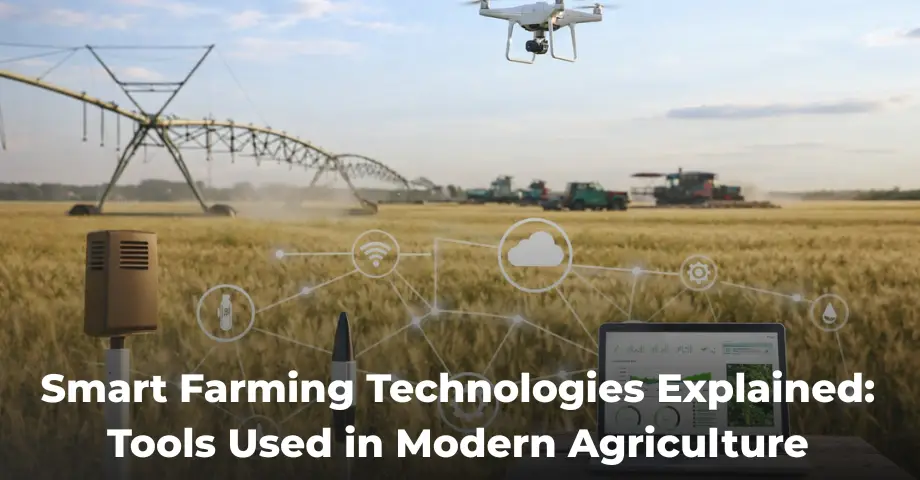
Walk onto a modern farm today and you will still see soil, crops, livestock, and machinery — but behind the scenes, something else is quietly at work. Data. Sensors. Software. Connections that help farmers understand what is happening on their land without relying purely on guesswork.
This is what people usually mean when they talk about smart farming technologies. It is not about turning farms into factories or replacing experience with machines. It is about using technology to see more clearly, react earlier, and make decisions based on real conditions rather than assumptions.
If you are trying to understand what technologies are actually used in smart farming, and what each one does in plain terms, this guide will walk you through it step by step.
Download PDF for Smart_Farming_Tools_Explained
Smart Farming, Explained in Simple Terms
At its heart, smart farming is about awareness. Knowing when soil is too dry before crops start suffering. Spotting disease early rather than after yields drop. Understanding patterns across a field instead of treating every hectare the same.
Technology makes this possible by collecting information, sharing it, and turning it into something useful. Most smart farms rely on a combination of sensors, connected devices, aerial monitoring, software platforms, and data analysis. Each tool has a different role, but they work best when used together. If you’re new to the concept, understanding what smart farming actually means helps put these technologies into context.
Sensors: The Farm’s Nervous System
Think of sensors as the farm’s nervous system. They sit quietly in the background, constantly measuring what is happening beneath the surface and in the surrounding environment.
On a working farm, sensors are commonly used to track soil moisture, temperature, humidity, and weather conditions. Some are placed directly in the soil, others are positioned around fields or inside buildings.
Why does this matter? Because conditions can change quickly, and what looks fine from a distance may not be fine at root level. A field might appear healthy, but soil moisture readings could already be dropping to levels that will stress crops within days.
Instead of relying on fixed schedules or visual checks alone, sensors give farmers real-time information. That data helps them decide when to irrigate, when to hold off, and when intervention is actually necessary.
IoT in Agriculture: Connecting Everything Together
Sensors become far more powerful when they are connected — and this is where IoT, or the Internet of Things, comes into play.
In agriculture, IoT simply means that devices across the farm can send data to each other and to central systems. Soil sensors, weather stations, irrigation controllers, and livestock trackers can all be part of the same network.
In everyday terms, this means a farmer does not need to be physically present to know what is happening. For example, if soil moisture drops below a set level, an IoT-connected irrigation system can alert the farmer — or even adjust watering automatically.
This kind of connectivity is especially valuable on larger farms or where fields are spread out. It saves time, reduces unnecessary trips, and allows quicker responses to changing conditions.
Drones: A Bird’s-Eye View of the Farm
Some issues on a farm are hard to spot from the ground. That is where drones come in.
Agricultural drones are used to capture detailed images of fields from above. They can reveal patterns that are invisible at eye level, such as uneven crop growth, water stress, or early signs of disease spreading.
Rather than walking an entire field, a farmer can use drone imagery to identify problem areas and focus attention where it is actually needed. This is particularly useful in precision farming, where small differences across a field can have a big impact on yield.
Drones do not replace on-the-ground checks, but they help farmers decide where to look first.
AI in Farming: Making Sense of Complex Information
As farms collect more data, another challenge emerges: understanding it all. This is where artificial intelligence, or AI, becomes useful.
AI systems are designed to spot patterns in large amounts of information. In agriculture, this might involve analysing soil data, weather trends, crop images, or historical yield records.
For instance, AI can help predict how a crop is likely to perform under certain conditions, or flag early warning signs of disease based on subtle visual changes. Instead of reacting after a problem becomes obvious, farmers can act sooner.
AI does not make decisions on its own. It supports farmers by highlighting risks, trends, and opportunities that would otherwise be difficult to detect.
Farm Management Software: Bringing Everything into One Place
All this data needs somewhere to live. That is the role of farm management software.
These platforms act as a central dashboard for farm operations. They pull together information from sensors, IoT devices, machinery, and records, presenting it in a structured way.
In practical terms, this helps farmers plan crops, track tasks, monitor inputs, and review performance over time. Instead of juggling notebooks, spreadsheets, and separate systems, everything is accessible in one place.
This centralisation is what turns smart farming from a collection of gadgets into a usable system.
Data Analytics: Turning Information into Action
Collecting data is only useful if it leads to better decisions. Data analytics is what bridges that gap.
By analysing patterns over weeks, months, or seasons, farmers can identify what works and what does not. Perhaps one part of a field consistently underperforms, or certain weather conditions affect yield more than expected.
Analytics helps answer those questions. Over time, it supports more confident planning and reduces reliance on trial and error.
The Challenges of Smart Farming Technologies
Smart farming is powerful, but it is not without challenges.
Reliable internet access remains an issue in many rural areas, which can limit the effectiveness of connected systems. There is also a learning curve — new tools take time to understand and integrate into daily routines.
Managing large volumes of data can feel overwhelming at first, especially when multiple technologies are involved. For this reason, many farms adopt smart tools gradually rather than all at once.
Recognising these challenges helps set realistic expectations and encourages smarter adoption.
How These Technologies Work Together on a Real Farm
In practice, smart farming is an ecosystem. Sensors collect information from the field. IoT systems connect devices and transmit data. AI analyses patterns. Software presents insights clearly. Analytics supports long-term planning.
When these elements work together, farmers gain a clearer picture of their land and can make decisions with greater confidence.
From Understanding to Action
Understanding smart farming technologies is the first step. The next step is deciding which tools actually make sense for a specific farm, based on size, crops, location, and goals.
Not every farm needs every technology. The value lies in choosing tools that genuinely support day-to-day decisions rather than adding unnecessary complexity. Once the technologies are understood, the next step is learning how to implement smart farming technologies on a farm in a practical, manageable way.
Final Thoughts: Technology That Helps Farmers See More Clearly
Smart farming technologies are reshaping modern agriculture, not by replacing farmers, but by supporting them. They provide insight, reduce uncertainty, and help manage the increasing complexity of farming today.
In smart farming, technology does not farm the land — it simply helps farmers see it more clearly.
Frequently Asked Questions (FAQ)
What technologies are used in smart farming?
Smart farming uses technologies such as sensors, IoT devices, drones, artificial intelligence, farm management software, and data analytics. Together, these tools help farmers monitor conditions, analyse data, and make better decisions.
How is IoT used in agriculture?
IoT is used in agriculture to connect devices like soil sensors, weather stations, and irrigation systems. These devices share real-time data, allowing farmers to monitor their farms remotely and respond quickly to changing conditions.
Is artificial intelligence really used in farming?
Yes, artificial intelligence is increasingly used in farming. AI helps analyse data from crops, soil, and weather to predict yields, detect diseases early, and support smarter decision-making on modern farms.
What do sensors do in smart farming?
Sensors measure conditions such as soil moisture, temperature, humidity, and weather. This information helps farmers understand what is happening in their fields and avoid relying on guesswork.
Why are drones used in agriculture?
Drones are used to monitor crops from above. They help farmers spot uneven growth, water stress, or early signs of disease across large areas, saving time and improving accuracy.
What is farm management software used for?
Farm management software brings together data from different tools in one place. It helps farmers plan crops, track tasks, manage inputs, and review performance over time.
What are the main challenges of smart farming?
Common challenges include limited internet access in rural areas, learning how to use new technology, managing large amounts of data, and integrating multiple systems smoothly.
Do all farms need smart farming technology?
No, not every farm needs every technology. Smart farming works best when tools are chosen based on the farm’s size, type, and specific needs rather than adopting everything at once.