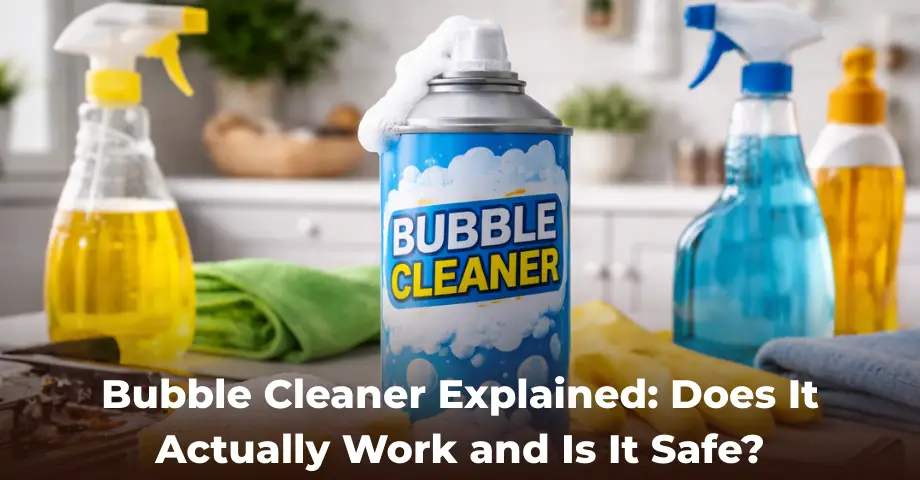
A bubble cleaner is a foaming cleaning spray that expands into thick foam to loosen grease and grime before wiping. Unlike ordinary liquid sprays, the foam clings to surfaces longer, allowing cleaning agents to break down dirt more effectively. It’s mainly used in kitchens and bathrooms where grease tends to build up.
If you’ve been anywhere near TikTok or Instagram cleaning videos lately, you’ve probably seen the same dramatic scene: a greasy hob sprayed with white foam, wiped once, and suddenly sparkling like a showroom kitchen.
That product is what most people now call a bubble cleaner.
Naturally, many households across the UK rushed to try it. Others looked at it with suspicion — after all, we’ve been promised miracle cleaning solutions before, and most ended up living permanently under the sink next to half-used polish sprays.
So the real question isn’t whether bubble cleaner looks impressive online.
The question is whether it actually works in normal homes with normal mess.
Let’s go through it properly — what it is, how safe it is, and when it’s worth using.
What Is Bubble Cleaner and How Does It Work?

Bubble cleaner is essentially a foam-based degreasing cleaner designed to stay on surfaces longer than liquid sprays. The foam spreads out and forms tiny bubbles that hold cleaning agents against dirt instead of running straight off.
Cleaning chemistry depends heavily on contact time. Traditional sprays often drip away before they’ve had a chance to break down grease. Foam slows that process down, giving the cleaning ingredients time to surround and loosen oily particles.
That’s why it tends to perform well on cooker tops, extractor fans and splashbacks — places where grease sticks rather stubbornly.
In simple terms, the cleaner itself isn’t necessarily stronger than a normal spray. It just works smarter by staying where you need it.
Bubble Cleaner Ingredients Explained

Most products share a similar formula.
Typical Bubble Cleaner Ingredients
-
Surfactants – lift oils
-
Solvents – dissolve stubborn grease
-
Alkaline agents – break down burnt food
-
Stabilisers – keep foam structure
-
Fragrance – because no one wants “industrial garage” scent
Many brands now advertise enzyme cleaning spray formulas. These use biological agents to digest organic grime rather than just loosen it.
UK Safety Standards
Under UK REACH chemical regulations, household cleaners must meet safety labelling standards. If it’s sold legally in the UK, it’s been assessed for consumer use — but that doesn’t mean misuse is impossible.
Bleach is legal too, and we all know how that ends on dark clothing.