How Many EV Charging Points Are There in the UK? (2026 Figures)
The UK had 126,140 public EV chargers at the end of October 2026. Here is how fast the network is growing, where coverage is best, and what it means for drivers.

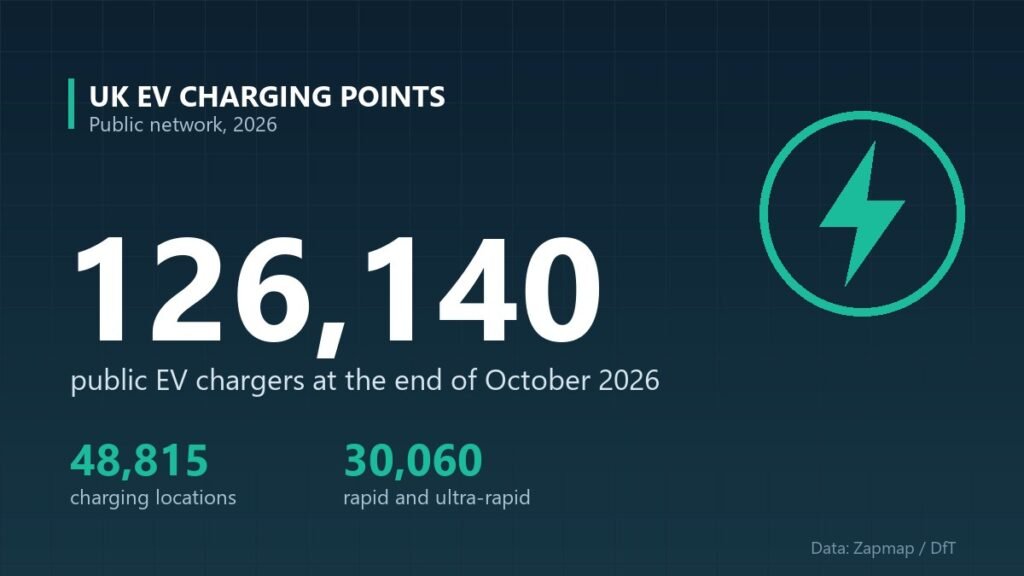
The UK had 126,140 public EV charging points at the end of October 2026, according to Zapmap, the mapping service that supplies the Department for Transport’s official charging data. Those chargers sit on 98,899 charging devices spread across 48,815 locations, and 30,060 of them are rapid or ultra-rapid units.
That is roughly 5,000 more chargers than at the start of July, and the network is still growing by around 1,000 to 2,000 chargers a month. Below we break down what the figures mean, how fast the network is expanding, which parts of the country are best served, and what it means if you are thinking about switching to an electric car.
How many EV charging points are there in the UK right now?
The latest snapshot, for the end of October 2026, looks like this:
| Measure | Figure |
|---|---|
| Public EV chargers (individual connectors that can charge a car) | 126,140 |
| Charging devices (the physical units those chargers sit on) | 98,899 |
| Charging locations (car parks, forecourts, streets and hubs) | 48,815 |
| Rapid and ultra-rapid chargers | 30,060 |
The difference between a “charger” and a “device” matters. One roadside post or forecourt unit can often charge two cars at once, so it counts as one device but two chargers. Since January 2026 both Zapmap and the government have used individual chargers as the headline figure, because it is a better guide to how many cars can actually plug in at the same time.
How fast is the network growing?
Month by month, the count has climbed steadily through 2026:
| Date | Public EV chargers |
|---|---|
| End of February 2026 | 118,321 |
| End of March 2026 | 119,080 |
| End of April 2026 | 120,388 |
| End of June 2026 | 121,171 |
| End of October 2026 | 126,140 |
The official Department for Transport release for 1 July 2026 put the year-on-year increase at about 10%. Growth also picked up in the second half of the year: almost 5,000 chargers were added between July and October, compared with roughly 2,800 in the whole of the previous four months.
One word of caution if you compare these numbers with older articles. Before 2026, most reports counted devices rather than chargers, so a figure from 2024 or 2025 is not directly comparable with the totals above. A jump that looks enormous on paper may be partly down to the change in how chargers are counted.
Slow, fast, rapid and ultra-rapid: what kind of chargers are they?
Not every charging point does the same job. Broadly, public chargers fall into these groups:
- Slow and fast chargers (up to about 22kW) are the lamp-post sockets, street bollards and car park posts you find in residential roads, supermarkets and town centres. They are ideal when a car is parked for several hours or overnight.
- Rapid chargers (roughly 50kW and above) can add a large amount of range in under an hour, and are common at service stations, retail parks and fuel forecourts.
- Ultra-rapid chargers (typically 150kW and above) are built for long journeys. A compatible car can go from low to around 80% in as little as 20 to 30 minutes.
Rapid and ultra-rapid chargers make up around a quarter of the network, with 30,060 of the 126,140 chargers in October 2026. That share matters most to drivers without a home charger and to anyone doing regular motorway miles.
Where are the most EV charging points in the UK?
Coverage is uneven. On the government’s 1 July 2026 figures, London had by far the densest network overall, at 345.1 public chargers per 100,000 people, helped by thousands of on-street lamp-post and bollard chargers.
The picture flips for rapid charging. London had just 27.9 rapid-or-faster chargers per 100,000 people, the second-lowest rate of any UK region. Scotland, by contrast, had 59.1 rapid-or-faster chargers per 100,000 residents, more than twice the London rate, reflecting years of investment along its trunk roads and in rural areas.
The thinnest coverage is in Northern Ireland and parts of the rural north and east of England. Drivers there are more likely to rely on home charging and to plan longer trips around specific hubs.
Per-person figures also need some context. City centres can look exceptionally well served because commercial hubs there are used by commuters and visitors as well as residents.
Is the UK on track?
The government has long pointed to an expectation of around 300,000 public chargers by 2030. At today’s pace of roughly 1,000 to 2,000 new chargers a month, the network would need to speed up considerably to get there. The recent rise in installations, more large charging hubs, and the steady rollout of local on-street charging funded through councils all point in the right direction, though.
For most drivers, the more important questions are practical: is there a reliable charger near home or work, and are there enough rapid chargers on the routes they use most? On both counts the answer is improving month by month, especially along major roads.
What this means if you drive, or are thinking about an EV
- Charge at home if you can. A home wallbox is still the cheapest and most convenient option for most drivers, and the public network is best treated as a top-up and long-distance backup.
- Check your local streets. If you do not have a driveway, look up on-street and car park chargers near you before you buy. Coverage varies a lot from one council to the next.
- Plan long journeys around rapid hubs. Motorway services and large hubs with several ultra-rapid chargers reduce the risk of queuing or arriving at a broken unit.
- Use a live map. Charging apps show which chargers are working and free in real time, which matters more than the national total when you are on the road.
Frequently asked questions
How many EV charging points are there in the UK in 2026?
There were 126,140 public EV chargers at the end of October 2026, on 98,899 devices at 48,815 locations, according to Zapmap’s monthly figures.
How many rapid EV chargers are there in the UK?
There were 30,060 rapid and ultra-rapid chargers at the end of October 2026, around a quarter of the public network.
Which part of the UK has the most EV charging points?
London has the most public chargers per person overall, at 345.1 per 100,000 people on the July 2026 government figures. For rapid chargers, though, Scotland leads London by a wide margin.
Why do different websites give different numbers?
Mostly because of timing and counting method. Some sources count physical devices, others count individual chargers, and the figures are updated monthly. Since January 2026 the official series has counted individual chargers.
Where do these figures come from?
The monthly totals come from Zapmap’s EV charging statistics, and the regional figures from the Department for Transport’s public electric vehicle charging infrastructure statistics for 1 July 2026.