



Peptides occupy an awkward middle ground in skincare. They’re more interesting than the ingredients with no evidence at all, and considerably less proven than retinol — which makes them hard to write about honestly without either overselling or dismissing.
The fair summary: plausible mechanisms, some promising studies, mostly small and often industry-funded, and a very good tolerability profile. Which makes them a reasonable addition for people who can’t use stronger actives, and an optional extra for everyone else.
Where they fit is in the anti ageing skincare routine guide.
What a peptide is
A short chain of amino acids — the building blocks of proteins. Collagen, elastin and keratin are all proteins made of amino acid chains.
The theory is that when collagen breaks down, it produces specific peptide fragments. The skin detects these fragments as a signal that damage has occurred, and responds by increasing collagen production. Apply those same peptides topically and, the reasoning goes, you trigger the repair signal without the damage.
It’s an elegant idea and there is genuine research supporting parts of it. Whether enough peptide penetrates deep enough, in real-world formulations, at the concentrations used, remains the open question.
The main types
Signal peptides. The collagen-stimulating group. Palmitoyl pentapeptide-4 (Matrixyl) is the best known and has more published data than most.
Carrier peptides. Deliver trace elements — usually copper — into the skin. Copper peptides (GHK-Cu) have research behind them for wound healing and some for skin appearance.
Neurotransmitter-inhibiting peptides. Argireline and similar, marketed as reducing expression lines by limiting muscle contraction. Sometimes called “Botox in a jar”, which considerably overstates it — topical application onto intact skin does not deliver anything to facial muscles the way an injection does. Evidence for meaningful line reduction is weak.
Enzyme-inhibiting peptides. Slow the enzymes that break collagen down, rather than building new collagen.
The honest comparison with retinol
Worth stating plainly, because a lot of marketing implies equivalence.
Retinol has decades of independent research and consistent, well-documented results for lines, texture and pigmentation. It also causes irritation, requires a careful introduction, and can’t be used in pregnancy.
Peptides have a much smaller evidence base, mostly from smaller and often manufacturer-linked studies. Results are subtler. They’re also extremely well tolerated, cause almost no irritation, and are generally considered fine in pregnancy.
If you can tolerate retinol, retinol is the better-evidenced choice — see retinol cream. Peptides are a good addition alongside it, and a reasonable alternative when retinol isn’t an option.
Who benefits most
People who can’t use retinoids. Pregnancy, breastfeeding, severe sensitivity, rosacea, or eczema. This is the clearest use case.
Sensitive skin generally. Peptides sting almost nobody.
Anyone with a compromised barrier. Some peptides support barrier repair directly, which is useful while recovering from over-exfoliation or retinoid irritation.
People already using retinol. Peptides layer well and work through different pathways.
Anyone in their thirties or forties starting to think about collagen. A gentle addition with no downside beyond cost.
Who probably doesn’t need one
Anyone in their early twenties without a specific concern.
Anyone not yet using sunscreen daily — that’s a far higher-return habit and should come first.
Anyone hoping for dramatic, visible line reduction. That’s not what peptides deliver.
Anyone on a tight budget who has to choose. Sunscreen, then retinol, then vitamin C, then peptides — in that order of evidence per pound.
How to use one
Morning, evening, or both — peptides aren’t photosensitising and don’t require a particular time.
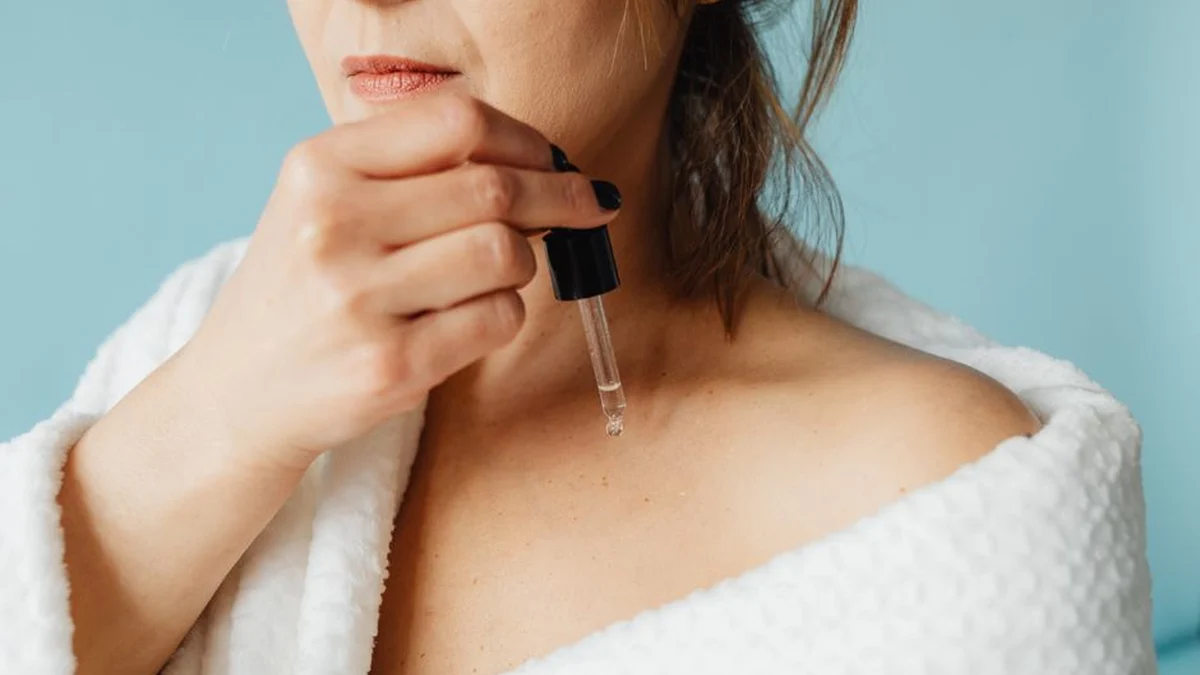
Apply to clean, dry skin, before heavier creams and oils. Peptides are water-soluble and need to reach the skin, not sit on top of an occlusive layer.
Pat gently, wait a minute, then continue with your routine.
Consistency matters more than quantity. Daily use for months is what any effect would require.
Combining with other actives
Most combinations are fine. Peptides are among the most compatible ingredients in skincare.
The one genuine caution is copper peptides with direct acids or high-concentration vitamin C, where there’s a theoretical concern about the low pH destabilising the copper complex. Use them at different times of day if you want to be careful — copper peptides in the evening, vitamin c serum in the morning.
Peptides and retinol together are fine, and often recommended. Peptides and niacinamide are fine. Peptides and hyaluronic acid are fine.
Reading the label
Two things to check.
Position in the ingredients list. Peptides are effective at low concentrations, so they’ll be low in the list — but if they’re after the fragrance and preservatives, there’s very little in there.
Whether the peptide is named. “Peptide complex” tells you nothing. Palmitoyl tripeptide-1, palmitoyl pentapeptide-4, acetyl hexapeptide-8 and copper tripeptide-1 are specific ingredients you can look up.
Price does not track efficacy here. Well-formulated peptide serums exist at supermarket prices, and £150 bottles are frequently the same actives in nicer packaging.
What to expect
Hydration and immediate smoothness: within days, largely from the base formulation rather than the peptides.
Firmness and texture: 8–12 weeks.
Any collagen-related change: 6 months of consistent use.
Results are subtle. Anyone expecting a dramatic transformation will be disappointed, and anyone expecting a gentle, cumulative improvement in skin quality is more likely to be satisfied.
For the eye area specifically, peptides are one of the more sensible active choices, because the skin there tolerates retinoids poorly — see eye cream. And if you’re looking for gentle actives more broadly, bakuchiol occupies similar territory.




Comments are closed