



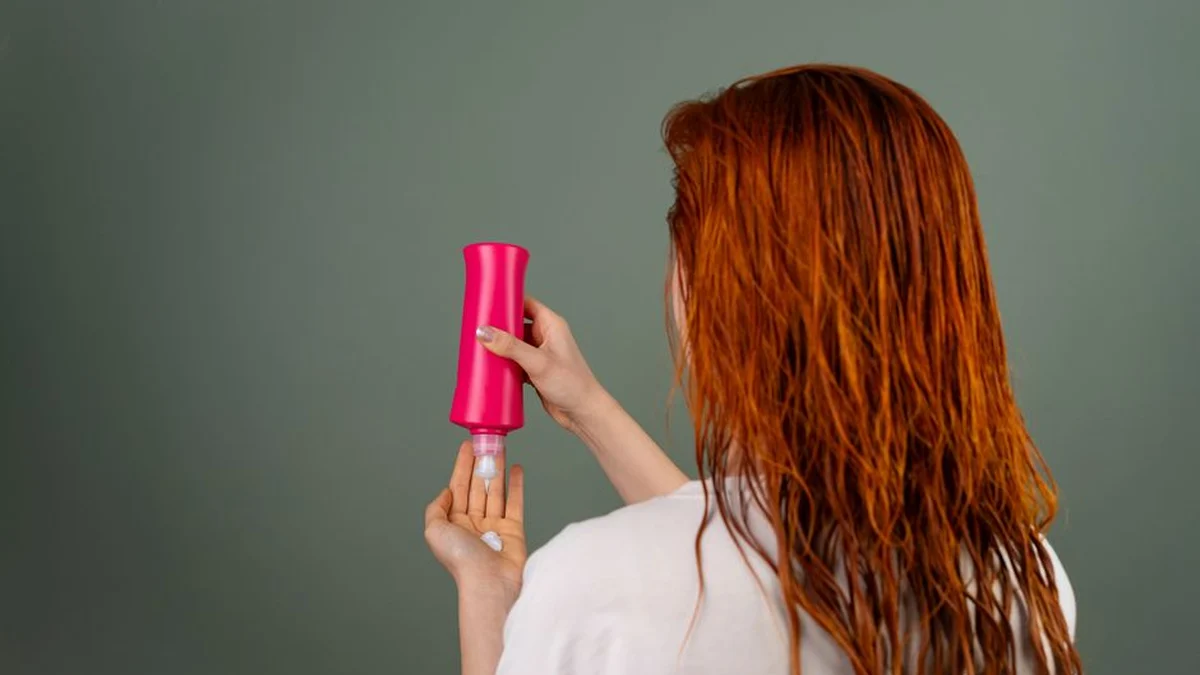
There is a gap in every coloured-hair routine, and it opens up around week four. The colour isn’t wrong exactly — it’s just tired. Flatter than it was. The red has gone slightly brown, or the copper has gone slightly beige, and the next appointment is a fortnight away.
The traditional options at that point were to live with it or to buy a box dye at nine o’clock at night, which is a decision people have been regretting for about forty years. Colour-depositing conditioners exist for exactly this gap, and they’re one of the genuinely useful innovations in home hair care.
They sit in the tone-maintenance part of a routine, alongside everything else in the hair colour care guide.
What they actually do
A depositing conditioner is a normal conditioner with direct dye pigment suspended in it. When you apply it, the pigment coats the outside of the hair shaft while the conditioning agents do their usual job.
Crucially, there’s no developer and no ammonia. Nothing lifts the cuticle, nothing penetrates the cortex, and nothing chemically alters your hair. The pigment sits on the surface and washes off gradually over four to eight shampoos.
This is why they can’t lighten, can’t cover grey properly, and can’t dramatically change your colour. It’s also why they’re almost impossible to get badly wrong, which is the point.
Depositing conditioner vs the alternatives
Versus box dye: box dye contains developer, permanently alters the hair, and produces a regrowth line. A depositing conditioner does none of those things. If you’re stretching time between salon appointments, this is the safe option and box dye is the one your colourist will be able to see from across the room.
Versus purple shampoo: different jobs. Purple shampoo neutralises unwanted yellow tones by cancelling them out. A depositing conditioner adds pigment back. If your blonde has gone brassy, use purple. If your red has gone dull, use a depositing conditioner. Using purple on faded red does nothing useful.
Versus a salon gloss: a gloss is stronger, lasts longer, and is applied with more precision. A depositing conditioner is the home version — weaker, shorter-lived, and considerably cheaper.
Choosing a shade
The single most useful rule: go one shade lighter than you think. Pigment builds with repeat use, and it’s easy to add more next week and impossible to remove it tonight.
Red and copper. The colours that fade fastest, and where these conditioners earn their keep most obviously. Red molecules are large and leak out of the cuticle quickly, so a weekly top-up genuinely extends the life of the colour.
Brunette. Choose based on whether your brown is fading warm or cool. Ash-toned conditioners counteract red pulling through; warm ones revive flatness.
Blonde. Golden, beige and champagne options add warmth back to blonde that’s gone flat or too ashy — the opposite problem to the one purple shampoo solves.
Fashion shades. Pink, blue, lilac, green. These fade fastest of all, and depositing conditioners are close to essential rather than optional if you want to maintain them.
Grey and silver. Silver-toned conditioners neutralise yellowing and add dimension.
How to use one
Wear gloves. Pigment stains skin and it’ll be on your palms for two days otherwise.
Apply to clean, damp hair — not soaking, which dilutes the pigment, and not dry, which makes it hard to distribute evenly.
Work through the mid-lengths and ends, using a wide-tooth comb to spread it. Skip the roots on your first go, unless you specifically want more depth at the top.
Timing is where people go wrong. Start with three to five minutes. That’s it. Not the twenty minutes on the tube. You can build intensity over successive uses; you can’t take it back off.
Rinse until the water runs clear.
Frequency: once a week for most colours, or every wash for fashion shades that fade in days.
The porosity problem
Here is the thing that causes most uneven results.
Damaged, bleached or previously coloured hair is more porous, so it grabs pigment faster and holds it longer. Healthy virgin hair barely takes it at all.
On a head that has both — say, healthy roots and bleached ends — the same product applied for the same time will produce dramatically different results in different places. The ends go too dark; the roots stay untouched.
The fix: apply to the least porous sections first, give them a head start of two or three minutes, then apply to the porous ends for the last minute or two. Or dilute the product with ordinary conditioner for the fragile sections.
What to expect, honestly
It refreshes and enriches. It does not change your colour, cover grey reliably, or lighten anything.
Grey hair has no pigment and a smooth, resistant cuticle. A depositing conditioner will tint grey strands slightly, but it washes off fast and the coverage is patchy. For visible regrowth at the roots, a root touch up spray works far better, and for genuine coverage you need actual colour — semi permanent hair colour being the gentlest option.
Removing it if you overdo it
Because the pigment sits on the surface, it comes off fairly readily.
Clarifying shampoo, two or three washes. A dish soap wash in an emergency, followed immediately by a deep conditioner. Hot water opens the cuticle and helps pigment escape — one of the few times you’d want a hot rinse.
Then deep condition, because everything on that list is drying.
Where it fits in a maintenance routine
Wash with sulphate-free shampoo, cool rinse, depositing conditioner once weekly, deep conditioning mask on a different day, chelating shampoo monthly if you’re in a hard water area.
Don’t stack a toning shampoo and a depositing conditioner on the same day unless you know exactly what you’re doing — they can pull tone in opposite directions and the result is muddy.
If your hair is highlighted rather than single-process, apply with more care, because the lightened pieces are the most porous parts of your head. The approach in balayage aftercare covers that specific situation properly.








Comments are closed