



Eye cream is the most emotionally-sold product in skincare and the one where expectations are furthest from reality. A great deal of it is sold on the promise of fixing dark circles, and a great deal of dark circles cannot be fixed by anything you apply to your face.
That’s not an argument against eye products. It’s an argument for knowing which of the three under-eye problems you actually have, because they respond to completely different things.
The broader routine context is in the anti ageing skincare routine guide.
Why the eye area is different
The skin around the eyes is considerably thinner than facial skin — often cited as around 0.5mm compared with roughly 2mm elsewhere. It has fewer oil glands, so it dries out faster. And it moves constantly: blinking, squinting, expressions. Tens of thousands of movements a day.
That combination is why fine lines appear here first, why the area reacts to products that the rest of your face tolerates, and why blood vessels underneath show through more visibly.
Do you need a separate product?
Sometimes. Not always.
You probably don’t if your face moisturiser is gentle and fragrance-free and your under-eye area is comfortable. Using it around the eyes is fine and saves money.
You probably do if you have a specific concern — persistent puffiness, crepiness, milia — or if your face products sting or cause irritation there. Face formulations often contain concentrations of actives or fragrance that the eye area doesn’t tolerate.
The honest position is that eye creams are frequently the same base formulation as a face moisturiser, in a smaller pot, at a higher price per millilitre. Some are genuinely different. The ingredients list tells you which.
Dark circles: work out which type
This is the section that saves people the most money.
Vascular (blue or purple)
Blood vessels showing through thin skin. Press gently — if it lightens, it’s vascular.
What helps: caffeine, temporarily, by constricting vessels. Vitamin K, modestly. Thickening the skin over time with retinoids or peptides.
What doesn’t: brightening ingredients, because there’s no pigment to brighten.
Honest expectation: improvement, not elimination. Concealer does more.
Pigmented (brown)
Excess melanin. Common in darker skin tones and often genetic. Doesn’t change when you stretch or press the skin.
What helps: vitamin C, niacinamide, azelaic acid, and rigorous sun protection — UV makes it worse.
Honest expectation: gradual improvement over months, with consistency.
Structural (shadow)
A hollow or tear trough casting a shadow. Look in a mirror with light from above, then with light from below — if it changes dramatically, it’s structural.
What helps topically: essentially nothing. This is anatomy.
What does help: concealer, or dermal filler if it genuinely bothers you.
Most people have a combination, and structural is more common than the industry lets on. If your dark circles run in your family and were there in your twenties, no cream is going to remove them.
Puffiness
Morning puffiness is fluid, and it’s temporary. Sleep with your head slightly elevated, reduce salt and alcohol the night before, and use cold — a chilled spoon, a cold compress, or a fridge-cold roller. Caffeine helps temporarily.
Persistent puffiness that never goes down is usually either fat pad prolapse, which is structural, or allergies. Neither responds to eye cream. Antihistamines help the second one, and it’s worth ruling out — a lot of people treat allergic puffiness with skincare for years.
Sudden, one-sided or painful swelling should be checked by a GP rather than treated cosmetically.
Fine lines
The area eye creams genuinely help with.
Retinoids are the best-evidenced option, but the eye area is where they irritate most. Use a formulation designed for it, start twice a week, and apply on the orbital bone rather than close to the lash line — the product migrates upward on its own. See retinol cream for the general method.
Peptides are the gentler alternative and a sensible choice here specifically, since tolerability matters more in this area than almost anywhere. See peptide serum.
Hyaluronic acid and glycerin plump temporarily, which makes fine lines less visible immediately. Real, but it’s hydration rather than structural change.
Sunscreen does more than any of them, and most people apply it to their face and stop at the eye sockets. Squinting in sunlight also creates lines, so sunglasses are doing genuine anti-ageing work.

How to apply
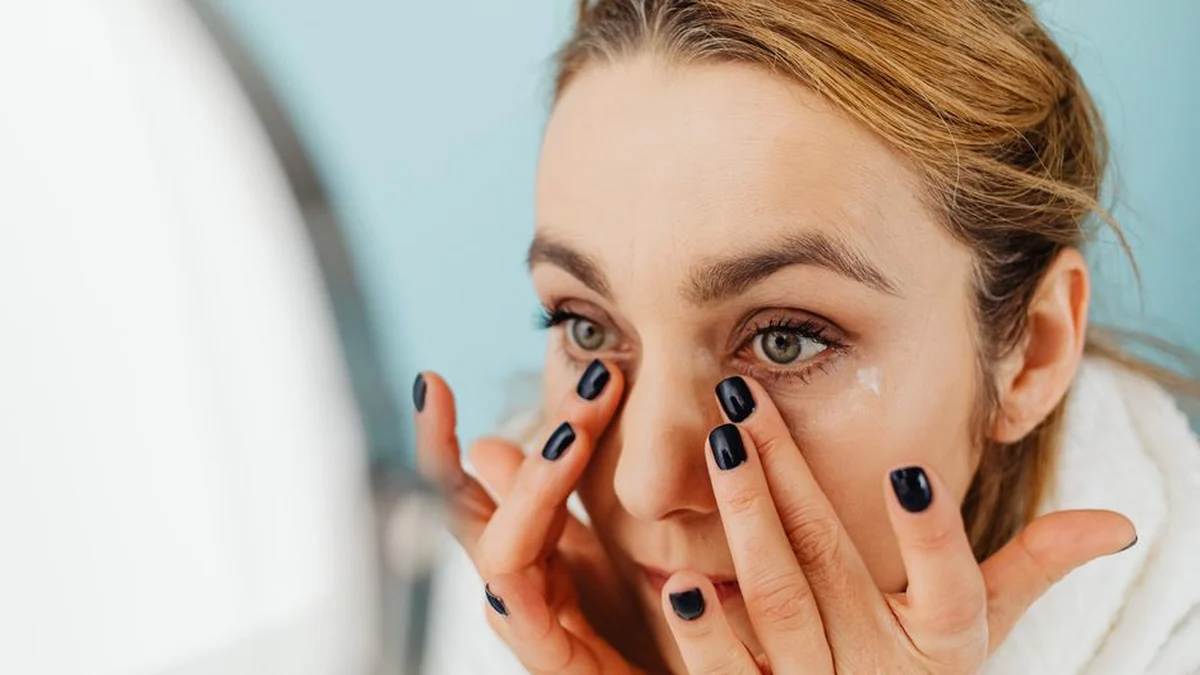
A grain of rice for both eyes. More is wasted and increases the chance of migration into the eye.
Use your ring finger, which applies the least pressure naturally.
Pat, don’t rub or drag. The skin here is thin and repeated tugging over years doesn’t help.
Apply on the orbital bone — the ridge you can feel around the eye socket — rather than right up to the lash line. Products spread and rise on their own with the warmth of the skin.
Serum first if you use one, then cream.
Milia
The small hard white bumps that appear under the eyes. Keratin trapped under the skin surface.
Heavy, occlusive eye creams can contribute to them in some people. If you get milia repeatedly, switch to a lighter gel or serum formulation.
Don’t try to extract them yourself — the skin here scars easily. A GP or a qualified aesthetician can remove them properly.
What genuinely helps beyond products
Sleep, which affects both puffiness and vascular circles more than any cream.
Sunglasses, which prevent both squinting and UV damage.
Reducing alcohol and salt, which affect fluid retention.
Not rubbing your eyes. Habitual rubbing — often from allergies — causes both pigmentation and laxity over years.
And a good concealer, which is not a defeat. For structural shadows in particular, it’s the only thing that works.
Realistic timelines
Hydration and temporary plumping: immediately.
Puffiness with cold and caffeine: minutes, temporarily.
Fine lines with a retinoid: 3–6 months.
Pigmented circles: 3 months or more.
Vascular circles: modest improvement over months.
Structural shadows: no change, ever, from topical products.
This article is general information, not medical advice. Sudden swelling, one-sided changes, pain, or vision changes around the eye should be assessed by a GP or optician rather than treated with skincare.








Comments are closed