From the outside, it often looks like a neat career move.
A presenter leaves the BBC, reappears on ITV, and carries on. Same face, same voice, different channel logo. To many viewers, it feels like a sideways step — or even a step up.
But if you look at what people in the UK are actually searching for, the questions tell a different story:
Why did that presenter seem to struggle after leaving the BBC?
Why does it work for some, but not others?
Is this about money, reputation, or control?
Would I make that move if I were in their position?
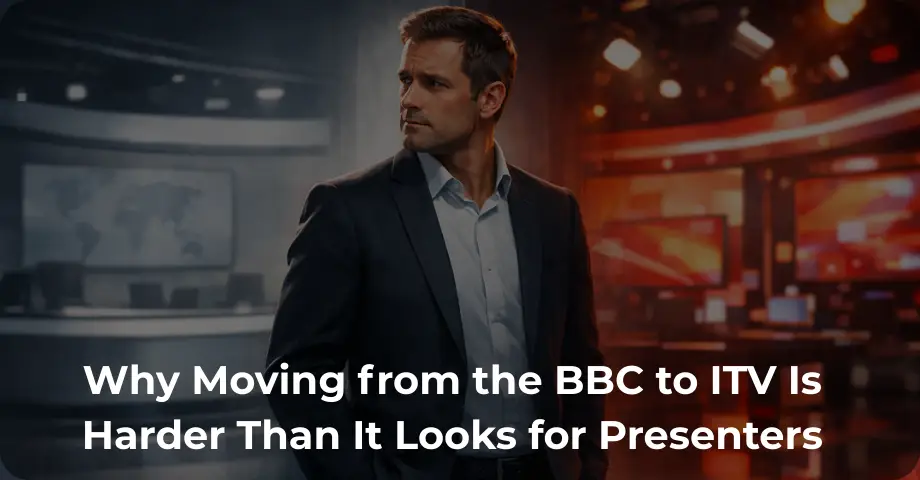
The honest answer is this: moving from the BBC to ITV isn’t just a job change — it’s a fundamental career reset.
And that reset comes with cultural, reputational, and emotional challenges that most viewers never see.
Let’s acknowledge the emotional reality first (because it matters)
People in the UK don’t just watch the BBC. They grow up with it.
The BBC is stitched into everyday life — breakfast television, radio on the school run, the six o’clock news. Presenters become part of routine, familiarity, and trust.
So when a BBC presenter leaves and turns up on ATV , the reaction is rarely neutral.
Viewers may not say it out loud, but they feel it:
Why did they leave?
What’s changed?
Is this still the same person?
That emotional friction sits underneath almost every search on this topic.
BBC vs ITV: the difference UK viewers instinctively understand
You don’t need a media studies course to sense the contrast.
How UK audiences tend to see the BBC
- Trusted
- Neutral
- Serious
- Calmly authoritative
- Public-service driven
BBC presenters benefit from institutional trust. Viewers often trust the role before they even assess the individual.
How UK audiences tend to see ITV
- Entertaining
- Personality-led
- Faster, more emotive
- Ratings-focused
- Commercial
On ITV, trust isn’t inherited — it’s earned, personally and repeatedly.
That difference explains why the same presenter can feel grounded on the BBC and exposed on ITV, even when their skills haven’t changed at all.
Why the move is harder than it looks in practice
1. Losing automatic credibility is a shock
At the BBC, presenters operate inside a protective layer of credibility. Criticism tends to bounce off the institution before it reaches the individual.
Once that layer disappears, the presenter stands alone.
Viewers may quietly ask:
- Are they still serious?
- Why leave public service broadcasting?
- Is this about money or fame?
None of this is fair — but it’s real. And rebuilding trust on ITV takes time, explanation, and the right role.
2. Contract reality: ITV is usually riskier
This is something audiences rarely see.
BBC contracts are often fixed-term but relatively stable, with strong editorial backing. Change is slower, more procedural, and carefully managed.
ITV contracts are more likely to be:
- Programme-specific
- Performance-driven
- Shorter-term
If a format doesn’t land, decisions happen quickly. That’s why some presenters appear briefly on ITV and then vanish again — not because they failed, but because commercial television is less forgiving.
So when people ask, “Is ITV riskier than the BBC?”
In most cases, the answer is yes.
3. Commercial pressure changes perception
ITV presenters work in a world shaped by ratings, advertisers, and immediate audience response.
BBC presenters are comparatively insulated from short-term dips. On ITV, success or failure can feel week-by-week — and that pressure subtly changes tone, pacing, and confidence on screen.
For presenters used to BBC protection, the adjustment can be uncomfortable — and visible.
When BBC-to-ITV moves have worked — and when they’ve been harder
Real, familiar examples help make this clearer.
Some transitions are structurally easier. Piers Morgan, for instance, moved from BBC current affairs into ITV’s Good Morning Britain — a personality-led format that suits commercial television. The role changed, not just the channel.
Similarly, Ben Shephard has often been cited as a smooth transition case, largely because his presenting style already aligned with ITV’s daytime output.
Claudia Winkleman shows how entertainment-focused presenters can move fluidly between broadcasters over time, without dragging heavy institutional expectations with them.
And Graham Norton is a strong example of a move working because the role evolved — combining presenting with creative and production involvement, rather than replicating a BBC format.
By contrast, presenters rooted in hard news and political journalism often face a steeper adjustment. Former Newsnight figures are frequently referenced in UK media discussions as illustrating how authority built in a public-service context doesn’t always translate cleanly into commercial formats.
That’s not about ability. It’s about fit.
Money vs control: the reality UK audiences often miss
There’s a persistent assumption that ITV simply pays more.
The reality is more complicated.
BBC pay is relatively transparent and comes with editorial protection and reputational cover. ITV can offer higher potential fees, but usually with:
- Less long-term security
- Greater exposure if a show underperforms
- Fewer institutional buffers
What presenters may gain in earnings, they often lose in control.
Understanding that trade-off makes these moves feel less cynical — and far more human.
Why viewers react more strongly than they realise
There’s also a psychological layer many people don’t consciously recognise.
The BBC is funded by the licence fee. That creates a subtle sense of shared ownership. When a presenter leaves, some viewers feel — emotionally, not rationally — that something they paid for has been taken away.
It’s not anger. It’s disappointment mixed with expectation.
That’s why BBC departures often provoke stronger reactions than similar moves elsewhere.
What presenters rarely say publicly
Most presenters won’t talk openly about the anxieties behind these transitions.
There’s a fear of being labelled “difficult”.
A fear of burning bridges.
A fear of being seen as disloyal to public service broadcasting.
So they leave quietly. And silence, unfortunately, allows speculation to fill the gap.
The reality worth sitting with
Moving from the BBC to ITV isn’t a promotion or a demotion.
It’s a career reset.
The BBC offers trust, stability, and institutional weight.
ITV offers opportunity, visibility, and creative range — but far less forgiveness.
That’s why the move looks simple from the outside, yet proves challenging so often in practice.
And the next time a familiar BBC face appears on ITV — or quietly disappears again — it’s worth pausing before assuming failure.
More often than not, you’re watching someone navigate a very different broadcasting world, with very different rules.
And that’s never as easy as changing channels.
Frequently Asked Questions (FAQ)
Why do BBC presenters struggle after moving to ITV?
Because BBC presenters benefit from automatic public trust and institutional protection. On ITV, credibility has to be earned individually, under greater ratings and commercial pressure, which can make the transition challenging.
Is ITV better or worse than the BBC for presenters?
Neither is objectively better or worse. The BBC offers stability, public-service credibility, and editorial protection, while ITV offers greater visibility and opportunity but less long-term security and tolerance for underperformance.
Why don’t more BBC presenters move to ITV?
Many presenters value the BBC’s institutional trust, job security, and editorial independence. Moving to ITV often means trading those benefits for higher risk and greater public scrutiny.
Does leaving the BBC damage a presenter’s reputation?
Not necessarily. However, some UK audiences subconsciously question a presenter’s motives or seriousness after leaving the BBC, especially if the new role feels commercially driven rather than editorially aligned.
Is moving from the BBC to ITV mainly about money?
Money can be a factor, but it’s rarely the whole story. ITV roles may offer higher potential pay, but often with less security and fewer protections than BBC positions.
Why does the move work for some presenters but not others?
It usually depends on role fit. Entertainment and lifestyle presenters tend to transition more smoothly than hard-news or political journalists, whose authority is closely tied to the BBC’s public-service identity.