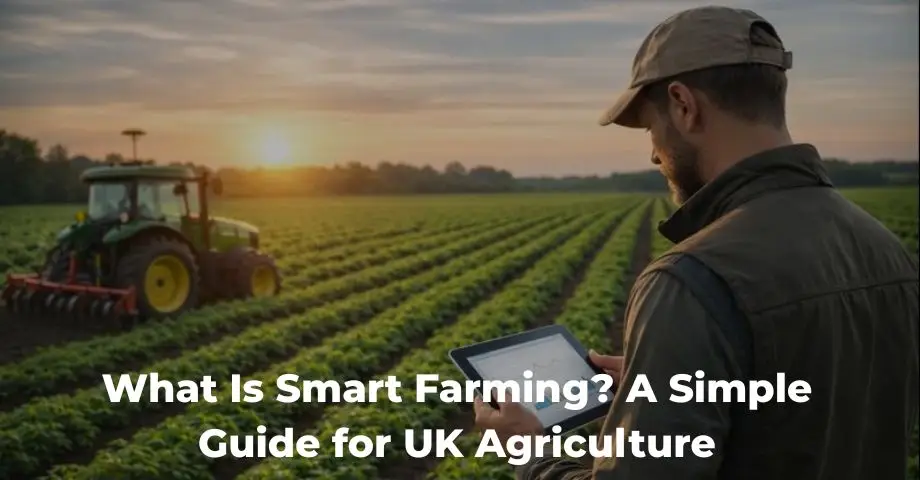
Farming in the UK has never been simple, but over the past decade it has become noticeably more complex. Weather patterns are less predictable, costs continue to rise, and finding reliable labour is harder than it used to be. Against this backdrop, many farmers and rural businesses keep hearing the same phrase and asking the same question: what is smart farming, and is it actually useful in day-to-day farming life?
You might have come across terms like smart agriculture, digital farming, or modern farming technology and wondered whether they describe something genuinely practical or just another industry trend. This guide is written to cut through that confusion. It explains what smart farming really means, how it works in practice on UK farms, and why it matters — without jargon, sales talk, or unrealistic promises.
What Is Smart Farming?
At its simplest, smart farming is about making better decisions by using better information.
When people ask what is smart farming in agriculture, they are referring to an approach where data and digital tools are used to understand what is happening on a farm more clearly and respond more accurately. Instead of relying only on routine, averages, or gut feeling, smart farming adds measured insight into everyday decisions.
This does not mean that experience suddenly becomes irrelevant. Quite the opposite. Smart farming works best when it supports existing knowledge. A farmer who already understands their land well can use additional information to fine-tune decisions, spot issues earlier, and avoid unnecessary work.
In the UK context, smart farming is increasingly seen as a practical response to modern farming pressures rather than a futuristic concept.
What Is a Smart Farm?
People often mix up the ideas of smart farming and a smart farm, so it’s worth clearing this up early.
- Smart farming is the method or mindset.
- A smart farm is what a farm looks like when that method is put into practice.
When someone asks what is a smart farm, they are usually imagining a farm that uses digital tools to monitor crops, livestock, soil, or equipment. In reality, a smart farm does not need to be highly automated or packed with technology.
Many UK farms become “smarter” in very small, sensible steps. A single system that tracks field conditions, alerts you to changes, or helps organise farm records can already move a farm into smart territory. It’s not about transforming everything at once — it’s about using information where it actually helps.
How Smart Farming Works in Practice
One of the biggest misunderstandings around smart farming is that it’s all about machines. In reality, it’s about information flow.
In practical terms, smart farming usually follows three stages:
1. Observing more accurately
This might involve collecting data about weather conditions, soil moisture, livestock movement, or equipment usage. Instead of relying on averages or occasional checks, conditions can be monitored consistently.
2. Understanding what the data is telling you
Data on its own is useless unless it highlights patterns. For example, noticing that one part of a field always dries out faster, or that livestock behaviour changes at certain times, helps identify issues earlier.
3. Acting with confidence
Armed with clearer information, farmers can make decisions that are more targeted and timely. This might mean adjusting routines, prioritising certain areas, or responding before small issues become costly problems.
Smart farming does not replace judgement. It simply reduces uncertainty.
Real-World UK Farming Situations Where Smart Farming Helps
To understand the value of smart farming, it helps to look at situations UK farmers recognise.
- Weather unpredictability: Sudden changes in rainfall or temperature can affect crops quickly. Having clearer visibility of conditions helps farmers respond rather than react late.
- Labour shortages: With fewer hands available, knowing where attention is most urgently needed saves time and effort.
- Field variability: Not every part of a field behaves the same way. Smart farming helps identify these differences instead of treating everything uniformly.
- Livestock health: Early signs of stress or unusual behaviour are easier to spot when monitoring is consistent.
These are not abstract ideas — they reflect everyday farming challenges.
What Is Climate Smart Farming?
You may also hear the term climate smart farming, which is closely related but slightly more focused.
When people ask what is climate smart farming, they are referring to practices that aim to:
- Adapt to changing climate conditions
- Reduce environmental impact
- Maintain productivity over time
In the UK, this matters because farming is increasingly affected by extreme weather, soil health concerns, and pressure to reduce emissions. Climate smart farming is not about perfection. It’s about using information to farm more responsibly and remain resilient in the face of change.
Why Smart Farming Matters for UK Agriculture
Smart farming matters because the pressures on UK agriculture are real and growing.
Many farms are dealing with:
- Higher input costs
- Reduced availability of labour
- Environmental expectations
- Tighter margins
- Unpredictable seasons
By improving visibility and understanding, smart farming can help reduce wasted effort and unnecessary expense. It does not guarantee success, but it can make outcomes more predictable and manageable.
For UK agriculture, smart farming is less about innovation for its own sake and more about long-term viability.
Smart Farming vs Traditional Farming
Smart farming is sometimes framed as a replacement for traditional farming, but that view misses the point.
Traditional farming relies heavily on:
- Experience
- Observation
- Knowledge built up over years
Smart farming adds:
- Measurement
- Monitoring
- Early warning signals
Many experienced UK farmers use smart tools precisely because they enhance traditional skills rather than replace them. Walking fields, checking livestock, and trusting instinct remain essential. Smart farming simply adds another layer of understanding.
Is Smart Farming Only for Large Farms?
This is one of the most common concerns — and a fair one.
Smart farming is often associated with large-scale operations, but in practice it is not limited by size. Smaller and medium-sized farms can benefit just as much, particularly when tools are chosen carefully.
For smaller farms, smart farming often focuses on:
- Saving time
- Reducing stress
- Avoiding costly mistakes
The key is relevance, not scale. Smart farming should solve real problems, not create new ones.
Common Concerns and Doubts About Smart Farming
People exploring smart farming often share similar worries.
“Is it too complicated?”
Most modern systems are designed to simplify work, not add complexity. The learning curve exists, but it is often less steep than expected.
“Will I need to change everything?”
No. Smart farming works best when introduced gradually. Many farms adopt one solution at a time.
“Is it reliable?”
Like any system, it depends on how it’s used. Smart farming supports decisions; it does not remove responsibility.
Addressing these concerns honestly helps set realistic expectations.
Smart Farming Is About Understanding Before Action
One of the biggest mistakes people make is jumping straight into solutions without fully understanding the concept. Smart farming is not about owning the latest tools. It’s about knowing why you need better information and where it will make a difference.
Understanding what smart farming is — and what it isn’t — helps avoid disappointment and wasted effort.
Final Thoughts
Smart farming is not a single system, product, or shortcut to success. It is a way of approaching farming that uses information to reduce uncertainty and support better decisions. For anyone asking what is smart farming, the most honest answer is that it helps farmers see what is happening on their land more clearly and respond with confidence.
For UK agriculture, smart farming offers a way to deal with modern pressures without abandoning traditional knowledge. Understanding the concept is the first step. From there, farmers can explore how smart farm solutions are implemented in practice, in ways that suit their land, their workload, and their long-term goals.
Frequently Asked Questions (FAQ)
What is smart farming in simple words?
Smart farming means using data and technology to understand what is happening on a farm and make better decisions. Instead of relying only on routine or guesswork, farmers use information to manage crops, livestock, and resources more accurately.
Is smart farming the same as precision agriculture?
They are closely related but not exactly the same. Precision agriculture focuses mainly on applying the right input at the right place and time, while smart farming is broader and includes data monitoring, decision support, and digital farm management.
Do you need technical skills to use smart farming?
No advanced technical skills are required to understand smart farming. Most systems are designed to be user-friendly. Many UK farmers start small and learn gradually, using tools that support rather than complicate daily work.
Is smart farming suitable for small farms in the UK?
Yes. Smart farming is not only for large farms. Small and medium-sized farms can use smart farming methods to save time, reduce waste, and make better use of limited resources. The key is choosing solutions that match real needs.
How does smart farming help with sustainability?
Smart farming supports sustainability by helping farmers use water, energy, and inputs more efficiently. By understanding conditions more clearly, farms can reduce unnecessary use of resources and limit environmental impact over time.
Is smart farming expensive to start?
Smart farming does not require changing everything at once. Many farms begin with simple monitoring or data tools. The focus should be on understanding the concept first, then choosing solutions that solve specific problems.
Does smart farming replace traditional farming methods?
No. Smart farming does not replace traditional farming knowledge or experience. It works alongside it, providing additional information to support decisions that farmers already make based on their understanding of the land and animals.
What is the difference between smart farming and digital farming?
Digital farming usually refers to using digital tools for record-keeping or planning. Smart farming goes a step further by using data to actively guide decisions and responses in real time.
Is smart farming reliable in the UK climate?
Smart farming is particularly useful in the UK because of changing and unpredictable weather. While it cannot control the climate, it helps farmers respond more quickly and plan more effectively around conditions.
What should I learn after understanding smart farming?
Once you understand what smart farming is, the next step is learning how smart farm solutions are implemented in practice, including which technologies are used and how they fit into day-to-day farm management.