
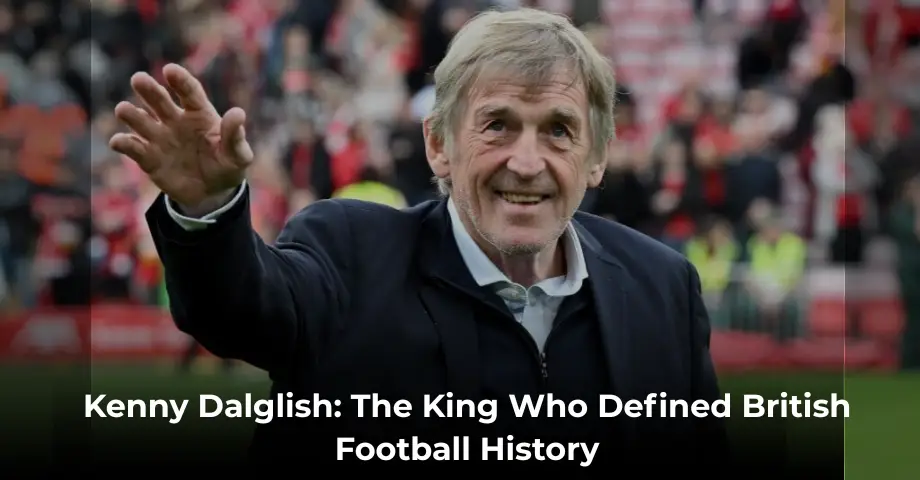
There are very few figures in British football whose influence cuts across clubs, eras, and emotions quite like Kenny Dalglish. To some, he is the greatest player Liverpool ever produced. To others, he is the standard-bearer of Scottish football excellence. And for many, he is simply King Kenny — a title earned not through noise or ego, but through consistency, intelligence, and humanity.
Dalglish’s story is not just about goals, trophies, or managerial success. It is about how football can be played with elegance, how leadership can be exercised with empathy, and how a public figure can carry responsibility with dignity. From the streets of Glasgow to the floodlights of Anfield, his career mirrors the evolution of modern British football itself.
Biography

Image source: pinterest.com
Why Kenny Dalglish Matters
Football history often remembers moments. Dalglish is remembered for standards.
He mattered because he redefined what excellence looked like in British football. He proved that intelligence could rival athleticism, that teamwork could outshine ego, and that leadership did not need volume to be effective.
As a player, he was trusted with the ball when it mattered most. As a manager, he was trusted with clubs during periods of triumph and trauma. And as a human being, he was trusted when football needed compassion more than results.
That combination is extraordinarily rare.
Early Life & Background

Image source: pinterest.com
Kenneth Mathieson Dalglish was born on 4 March 1951 in Glasgow, a city where football is deeply entwined with identity and pride. Growing up in a working-class environment, he learned early that talent alone was not enough. Discipline, humility, and effort mattered just as much.
From a young age, Dalglish displayed an unusual calm. He didn’t rush the ball. He didn’t force moments. He seemed to understand space, timing, and movement instinctively. Coaches noticed not just his skill, but his temperament — a quality that would later define his career.
Education & Early Football Influences

Image source: pinterest.com
Dalglish developed through Celtic’s famed youth system, emerging from the legendary “Quality Street Gang”, a group that shaped the club’s future in the late 1960s and early 1970s.
At Celtic, expectations were immense. Success was demanded, not hoped for. Dalglish learned the values of combination play, positional intelligence, and collective responsibility. He was taught that football was a shared language — one where the best players made others better.
Those lessons stayed with him for life.
Playing Career
Celtic FC (1969–1977)
Dalglish broke into Celtic’s first team as a teenager and quickly became a central figure. Over nearly a decade at the club, he made more than 200 appearances, winning multiple Scottish League titles and domestic cups.
He was not simply a goalscorer. He was a creator, a facilitator, and often the player who made decisive moments possible for others. His ability to drift between midfield and attack made Celtic’s play fluid and unpredictable.
By the mid-1970s, it was clear that Dalglish was destined for a larger stage.
Liverpool FC (1977–1990)
In 1977, Liverpool signed Dalglish for a then British-record transfer fee, tasking him with replacing Kevin Keegan — one of the most daunting transitions imaginable.
Dalglish handled it with remarkable composure.
Across 13 seasons at Liverpool, he:
- Made 515 appearances
- Scored 172 goals
- Won multiple English First Division titles
- Lifted the European Cup three times as a player
- Added FA Cups and League Cups to his honours
Playing primarily as a striker or second striker, Dalglish was never defined by raw pace. His game was built on anticipation, movement, and decision-making. He made football look simpler than it was — the hallmark of truly great players.
Anfield didn’t just embrace him. It anointed him.
Iconic Matches & Defining Moments

Image source: pinterest.com
Dalglish’s greatness was not confined to highlight reels. It lived in the rhythm of matches.
On European nights, he dictated tempo. In title run-ins, he delivered when margins were tight. Supporters often recall how the game seemed to slow when Dalglish had possession, as if he was operating on a different wavelength.
His best matches were rarely loud — but they were decisive.
Scotland Career: A National Icon
Dalglish represented Scotland with distinction, earning over 100 international caps and scoring 30 goals, placing him among Scotland’s all-time top goalscorers.
He featured in:
- FIFA World Cups
- European Championship qualifying campaigns
While Scotland never achieved major tournament success during his era, Dalglish’s individual reputation never diminished. He is widely regarded as Scotland’s greatest international footballer — not only for his talent, but for the responsibility he carried.
Managerial Career
Liverpool Manager (1985–1991)
Dalglish became player-manager of Liverpool in 1985, stepping into one of the most demanding roles in football.
As manager, he:
- Won multiple league titles
- Secured FA Cup victories
- Achieved the League & FA Cup double in 1985–86
He balanced authority with empathy, maintaining Liverpool’s dominance while managing personalities, pressure, and expectations.
Hillsborough & Leadership Beyond Football
In 1989, the Hillsborough disaster changed football forever.
As Liverpool manager, Dalglish placed humanity above results. He attended funerals, supported grieving families, and stood alongside a traumatised community. On Merseyside, this compassion is never forgotten.
For many, this was the moment when King Kenny became more than a nickname.
Blackburn Rovers (1991–1995)
Dalglish later guided Blackburn Rovers to the 1994–95 Premier League title, one of the most remarkable achievements in English football history.
It confirmed that his managerial brilliance extended beyond Liverpool.
Career Timeline
Style of Play & Football Intelligence
Dalglish was never about physical dominance.
His strengths were:
- Vision and spatial awareness
- Intelligent movement
- Link-up play
- Composed finishing
- Leadership through example
He controlled matches through understanding rather than force — a quality that influenced generations of players and coaches.
Kenny Dalglish Net Worth (No Official Figure)

Image source: pinterest.com
Important context: Kenny Dalglish has never publicly disclosed his financial details, and no official net worth figure exists.
Based on elite playing contracts, successful managerial careers, media work, ambassadorial roles, and endorsements, industry estimates suggest his wealth sits comfortably in the multi-million-pound range.
His income has come from:
- Playing contracts at Celtic and Liverpool
- Managerial salaries at Liverpool and Blackburn
- Media, ambassadorial, and documentary work
- Endorsements and public appearances
All financial figures are estimates based on publicly available information and industry context. No official net worth has been disclosed.
Family Life & Personal Values

Image source: pinterest.com
Dalglish has been married to Marina Dalglish for decades. Together, they have children and grandchildren.
Despite worldwide fame, he has always protected his family’s privacy. There has been no tabloid drama, no manufactured controversy. Family has always come first.
Charity Work: The Marina Dalglish Appeal
Founded in 2004 following Marina Dalglish’s recovery from breast cancer, The Marina Dalglish Appeal has raised over £10 million for cancer care.
The charity funds vital treatment facilities in Liverpool and beyond, forming one of the most meaningful parts of Dalglish’s legacy.
Honours & Achievements
Why Kenny Dalglish Is Still Searched Today
People don’t search for Kenny Dalglish only for statistics or trophies.
They search for meaning. For leadership. For proof that greatness and decency can coexist in elite sport.
In a game often obsessed with spectacle, Dalglish represents substance.
Reflective Conclusion
Kenny Dalglish was not just a footballer.
He was a benchmark.
A benchmark for intelligence on the pitch, responsibility off it, and compassion when football needed it most. Long after the goals fade into history, what remains is respect.
And in football, that may be the greatest legacy of all.
Sources & References
BBC Sport Profile
BBC Interviews & Documentaries
Wikipedia
Liverpool FC Official History
Scottish FA Records
If you love to read about football player you can also check other footballer profile in Briton News.
Adam Lallana full biography including net worth.
James Milner full biography including net worth.
FAQ
1. Who is Kenny Dalglish?
Kenny Dalglish is a Scottish football legend, former player and manager, best known for his success with Celtic, Liverpool, and the Scotland national team.
2. Why is Kenny Dalglish called “King Kenny”?
He earned the nickname “King Kenny” due to his extraordinary impact at Liverpool as both a player and manager, combined with his dignity, leadership, and success on and off the pitch.
3. How many goals did Kenny Dalglish score for Liverpool?
Kenny Dalglish scored 172 goals in 515 appearances for Liverpool across all competitions.
4. How many European Cups did Kenny Dalglish win?
He won three European Cups as a player with Liverpool and later won additional honours as a manager.
5. Is Kenny Dalglish a Sir?
Yes. Kenny Dalglish was knighted in 2018 for his services to football, charity, and the community.
6. What role did Kenny Dalglish play after the Hillsborough disaster?
As Liverpool manager, Dalglish prioritised supporting victims’ families, attending funerals, and providing leadership during one of football’s darkest periods.
7. What is Kenny Dalglish’s net worth?
There is no official public figure. His wealth is estimated to be in the multi-million-pound range based on his football career, management roles, and media work.
8. Why is Kenny Dalglish still important in football today?
He represents intelligence, compassion, and leadership in football, setting standards that continue to influence players, managers, and clubs.