



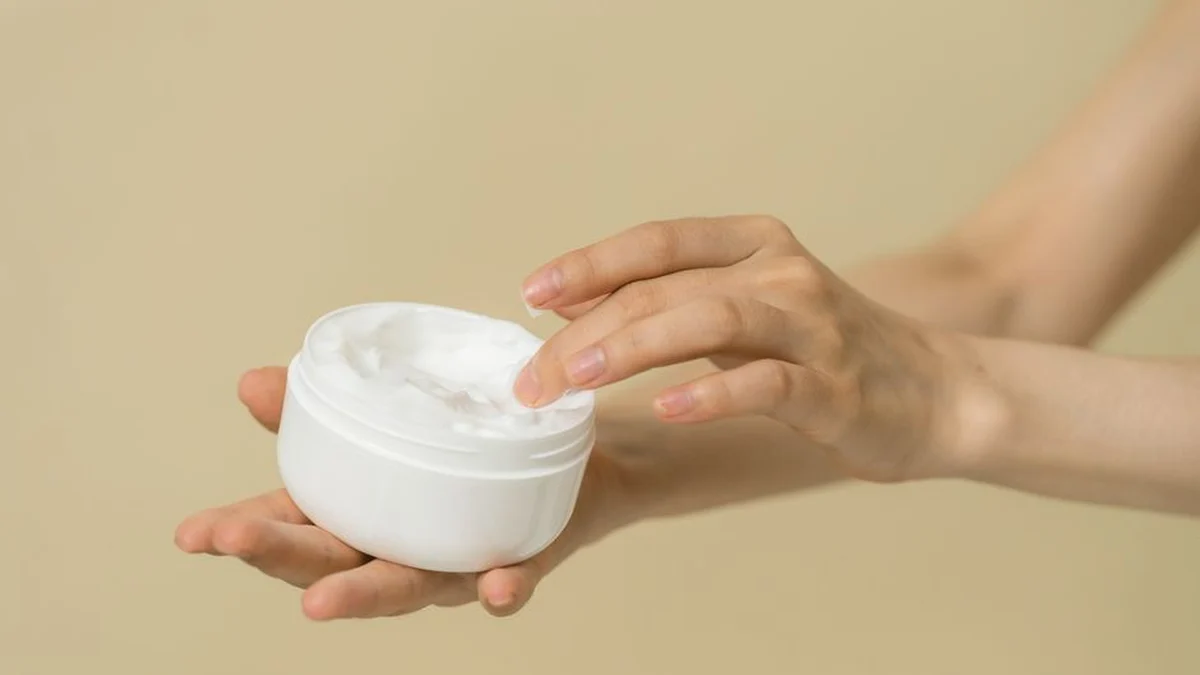
Cream is the product people reach for when gel has disappointed them. It feels kinder, it smells better, and it does not leave the hair hard. Then the curls drop by mid-afternoon and the conclusion is that cream doesn’t work.
Cream works. It just isn’t a hold product, and asking it to survive a damp British afternoon on its own is asking the wrong thing of it. Where it sits in the wider stack is set out in the guide to curly hair products; this is the detail on the cream itself, how much, how wet, in what order, and what to do when it goes wrong.
What cream is actually for
A curl defining cream is doing three jobs at once, and the balance between them varies enormously from bottle to bottle.
Humectants such as glycerin and aloe pull water towards the strand. Emollients such as shea, mango butter, jojoba and argan coat it, seal the cuticle flat and add slip. Film-forming polymers are the part that actually holds a clump together while it dries.
Compare that with gel, which is almost entirely film-former and barely moisturises at all. Cream feeds the strand; gel holds the shape. They are not competitors, and the people who get the best results from either are usually using both.
An uncomfortable fact about the category
“Curl cream” is a marketing label, not a formulation standard. Two products sitting next to each other on a shelf, both called curl cream, can be completely different things: one a conditioning emollient with essentially no hold, the other a polymer-heavy styler that behaves more like a soft gel.
Texture tells you nothing. A thick, rich-feeling cream can have less hold than a runny one. The only way to know is to use it and watch what happens as it dries. If the curls set into shape, there are film-formers in there. If they go soft and separate, there aren’t.
Which leads somewhere most guides won’t go: you may not need both a leave-in and a cream. If your hair dries soft, detangled and defined with a leave-in alone, the cream is a step you are performing out of habit. If your cream conditions well enough on its own, the leave-in is the redundant one. Take one out for two wash days and see whether anything gets worse.
How much, honestly
Dosing is where this goes wrong in both directions, and under-dosing is by far the more common of the two. People are so frightened of greasy hair that they use a third of what their head needs, then conclude the product is useless.
A workable scale, in coins, on soaking wet hair:
- Loose waves (2A): a 5p piece
- Waves with more definition (2B–2C): a 10p piece
- Curls (3A–3B): a 20p piece, roughly a tablespoon
- Tight curls into coils (3C–4A): a 50p piece, roughly two tablespoons
- Coils (4B–4C): a full handful
Then adjust for density, which is the variable the scale doesn’t capture. A great deal of hair needs more; fine strands need less. On long, thick hair you may need that amount per section rather than in total, and that is a very large difference. It is the reason two people can follow the same instruction and get opposite results.
Whatever the amount, emulsify it between your palms first. Cream applied straight from the hand in one blob coats a stripe of hair and leaves the rest bare. Rub it out until your palms are evenly slick, then apply.
How to tell you got it wrong
Too much: greasy lengths, no volume, a dull rather than shiny finish, and a residue at the roots.
Too little: curls that form and then separate, frizz that hasn’t reduced at all, and no hold by lunchtime.
If you have over-applied and the hair is still wet, you have not ruined the day. Rinse the section under the shower without shampoo, squeeze out the water, and reapply less. Every guide tells you to “use less next time”, which is true and unhelpful when you are standing in a bathroom at eight in the morning.
Soaking wet or damp? The argument, settled
You will find both instructions given with equal confidence, which is maddening. The truth is that they are not disagreeing about what is correct. They are disagreeing about what you want.
Water is the distribution vehicle. It is what lets the cream spread evenly, and it is what holds a clump together while the product sets around it. So:
Soaking wet, dripping, straight out of the shower: this gives the tightest clumps and the most definition. This is the default, and it is what most people mean when they say a routine “finally worked”.
Damp, squeezed out and towel-scrunched: this gives a softer, looser, more elongated set with more apparent volume and less definition.
Neither is wrong. But choose deliberately. Applying to damp hair by accident, because you got distracted and the hair dried while you were looking for the bottle, is the commonest reason a routine that worked last week didn’t work today. By the time hair is towel-dry the pattern has largely set, and the cream is sitting on the outside of a decision that has already been made.
Application: the part that decides the result
Section the hair first. Three sections for medium density, four to six for thick. Unsectioned application on a lot of hair produces definition at the front and frizz underneath, every time.
Then two motions, doing two different jobs:
Rake with closed fingers, running from mid-length to ends. This distributes and smooths the cuticle. Claw-shaped, spread fingers will pull the clumps apart rather than coating them. Keep the fingers together.
Scrunch upwards from the ends towards the scalp. This is what forms the clumps and builds bounce.
Doing only one gives you either even coverage with no definition, or definition in patches. Two techniques worth knowing on top of that: Praying hands means smoothing the cream down the length between flat palms, which gives the sleekest, most elongated result and suits looser waves. Squish to condish means cupping water in your hands and squishing it up into the hair with the product still in it, which gives noticeably more clump on tighter curls.
Keep it off the roots. There is no curl to define at the scalp, and it will look unwashed by the afternoon.
Then stop. Do not comb it, do not check on it, do not run your hands through it while it dries. Every contact breaks a clump.
Layering cream with gel
This is the fix for cream that drops.
Cream first, on soaking wet hair, raked and scrunched. Then gel over the top, scrunched in while the hair is still very wet. The cream does the moisture, the gel builds the cast, and when you break the cast at the end you get soft, defined curls rather than either crunch or collapse.
The reverse order does not work. Gel underneath, cream on top, and the cream simply breaks the cast down before it has set.
One error worth naming because nobody does: double-creaming. Using a leave-in cream and a styling cream and a curl milk in the same wash day, on the theory that more moisture must be better, is a reliable route to limp, weighed-down hair that never dries properly. One cream-type product per wash day.
If you find even a cream-and-gel combination fails on genuinely muggy days, the problem is atmospheric moisture rather than the products, and a humidity resistant hair spray as a final layer is the thing that holds.
Why yours might not be working
Work through these in order rather than buying something new.
White specks, or the product rolling into little balls. This is pilling, and it is almost never the cream’s fault on its own. It is either too much total product, or two layers that don’t get on, commonly a silicone-containing product under or over a water-based one. Cut the total volume first. If it persists, strip back to one product and reintroduce the second next wash day.
Soft, but no definition. Not a moisture problem. You need hold, and more cream will not supply it, a frizz control gel over the top is the answer.
Greasy lengths within hours. Too much product, or build-up underneath it. Cream cannot penetrate a coated strand, so if the hair feels slippery when dry and resists getting properly wet in the shower, clarify before you change anything else. In hard-water areas you need a chelating wash rather than an ordinary clarifying one, the clarifying shampoo guide covers the difference.
Frizz only at the crown. Uneven application to the canopy. That top layer gets the least product because it is the last place your hands go. Do it first next time.
Rough, straw-like ends. Not a styling problem at all. That is a conditioning or damage issue, and no styler fixes it, the curl revival products guide covers the diagnosis.
The formula is simply too heavy for you. Shea butter, mineral oil or petrolatum near the top of the ingredients list will flatten fine curls no matter how little you use. If your hair goes limp with any cream at any dose, cream is not your product, a curl enhancing mousse gives definition with a fraction of the weight.
Fine and dense is not the same as fine and sparse
This distinction matters more than any other and almost nobody makes it. Thickness of the individual strand and thickness of the ponytail are separate measurements.
If your strands are fine but you have a great deal of hair, you need a large volume of a low-weight product, which is the actual argument for mousse over cream, rather than the vague advice to “use something light”. If your strands are fine and there aren’t many of them, you need less of everything and one product is usually the whole routine.
Two things about British weather
Glycerin cuts both ways. It is in most creams and it is genuinely useful for about eight months of the year. But in very dry air, a flat with the heating on all winter, a humectant can pull moisture out of the hair rather than into it, and curls go brittle. In very high humidity it pulls in more water than the strand can hold, the cuticle swells, and the curl puffs regardless of technique. If your routine is reliable in spring and falls apart in a muggy August, you haven’t done anything wrong; move to a lower-glycerin cream for that stretch and put stronger hold over the top.
Hard water builds up faster under cream than under anything else. Across London, the South East and East Anglia, calcium and magnesium bind readily to the emollients in a cream. The result creeps up on you: definition fades week by week, hair starts to feel coated, and products stop absorbing. In those areas a chelating wash every three weeks or so keeps it in check, more often than the monthly interval that suits lighter products, precisely because cream gives the minerals more to cling to.
Cream on day two
Not neat. Cream on dry hair sits on the surface, looks greasy and does nothing for the shape.
Day two is a water job. Mist the section properly damp, put a very small amount of cream in wet palms so it dilutes, and squeeze upwards. A curl refreshing spray does the same thing with less faff, because what actually re-forms the clump is the water reactivating the product already in your hair.
If the curls have genuinely gone flat rather than just creased, a proper wash day is the honest answer. And if you want the shape back without heat, setting damp hair for heatless curls overnight does more than any amount of refreshing.
The short version
Cream moisturises, gel holds. Emulsify it, section the hair, apply to soaking wet lengths unless you have deliberately chosen a softer look, rake then scrunch, keep it off the roots, and leave it alone until it is completely dry.
Use more than you think, under-dosing is the commoner error. Use one cream-type product per wash day, not three. And if it pills, cut the total amount before you blame the bottle.




Comments are closed