



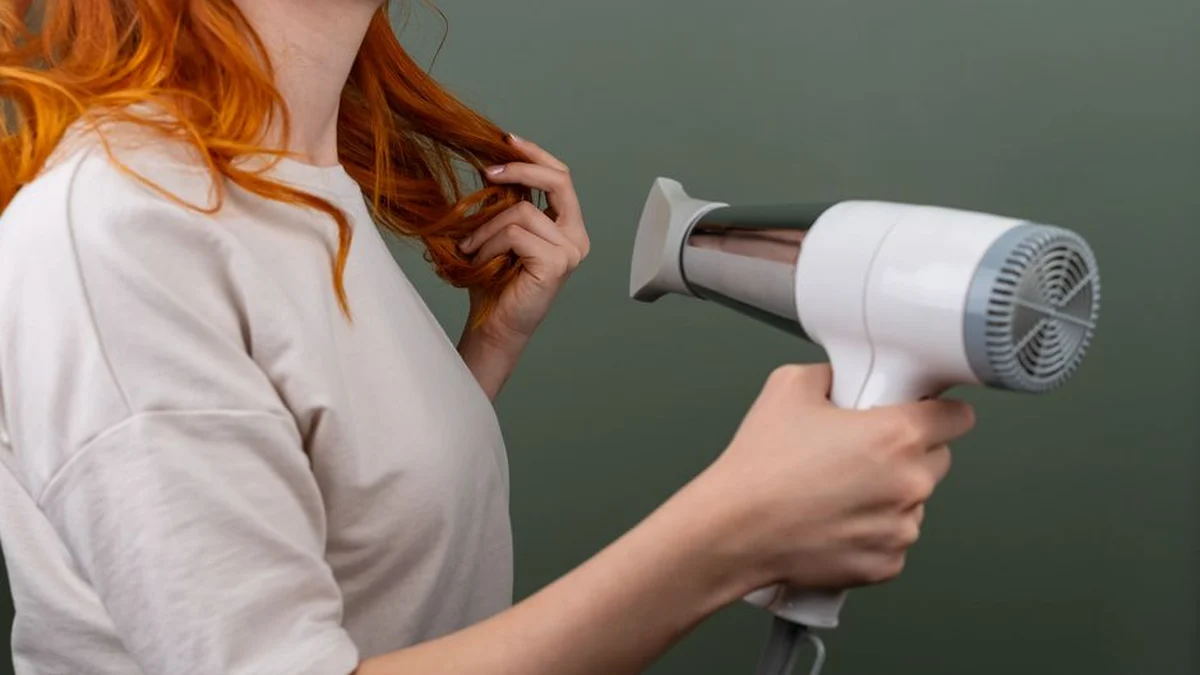
Almost everyone who owns a hair dryer feels slightly guilty about using it. Air drying is the virtuous option, blow drying is the shortcut, and the price of the shortcut is your hair.
That is the received wisdom, and there is a piece of research that complicates it considerably.
The study worth knowing about
In 2011, a team publishing in the Annals of Dermatology compared hair dried naturally with hair dried using a dryer at a range of temperatures, looking at the structure of the strand, its moisture content and its colour after repeated washing and drying.
Surface damage rose with temperature, exactly as you would expect. But there was a second finding that most people never hear about.
The cell membrane complex was damaged only in the naturally dried group. The cell membrane complex is the glue holding the cuticle cells to each other, and it is a structural part of the strand rather than a surface coating.
Their conclusion was that a hair dryer held 15 centimetres away and kept moving caused less damage than letting hair dry on its own.
Both halves of that sentence carry weight. This is not a licence to blast your hair on maximum from five centimetres. Held close and held still, a dryer is worse than either option. It is the specific combination of distance and movement that comes out ahead.
Why leaving hair wet is not free
Hair swells when it holds water and contracts as it dries. That is normal and happens every time you wash it.
The problem is duration. Sitting in a swollen state for two hours puts sustained strain on the structure holding the cuticle cells together, and repeated over months that shows up as the cell membrane complex breaking down. It is the same mechanism behind over-moisturised hair going limp and mushy, covered in the curl revival products guide.
So the honest position is not “blow drying is good”. It is that both extremes cost you something, and the middle is where the hair does best: blot properly, let it air dry part of the way, then finish with a dryer at a sensible distance.
Distance and movement beat the spec sheet
The temperature that actually reaches your hair has surprisingly little to do with the number on the box. It depends on how far away the dryer is, whether it is moving, the nozzle, the airflow, how wet the hair is and how thick it is.
Of those, the two you control completely are distance and movement, and they matter more than the machine’s maximum rating.
- 15 to 20 centimetres away. About the length of your hand plus a bit.
- Never park it. Constant movement, even when you are working on one section.
- Blot first. Every minute of water you remove with a towel is a minute you are not removing with heat.
Do those three things and a 2200W dryer delivers less heat to your hair than a 1600W one held close and stationary. The technique genuinely outranks the hardware.
Wattage is the wrong number
Wattage measures how much electricity the dryer consumes. It does not measure how much air it moves, and air is what dries hair.
The two are related, because a bigger motor generally pushes more air. But a high-wattage dryer with badly designed airflow will lose to a lower-wattage one with a well-engineered path, and you cannot tell which is which from the box.
Airflow is measured in cubic metres per minute. Almost nobody publishes it, which is inconvenient, and the practical workaround is to hold the dryer in a shop and feel the force of the air rather than reading the label.
As a starting point:
Fine or short hair: 1400 to 1800W is plenty.
Thick or long hair: 2000W and up.
And here is the part that inverts most people’s instinct. A powerful dryer used properly is gentler than a weak one, because you finish in eight minutes instead of twenty and the hair spends less than half as long under heat. Power is not the enemy. Time under heat is.
What actually justifies a higher price
Most of the difference between a £30 dryer and a £300 one is marketing. Two things are not.
The motor. Budget and mid-range dryers use brushed motors, which work perfectly well and wear out, because the brushes physically abrade in use. Brushless motors are quieter and last far longer, with premium models regularly running six or seven years of daily use. If you dry your hair every day, that is a genuine calculation rather than a brand story.
Airflow engineering. The reason expensive dryers dry faster is usually the air path rather than the wattage. You feel it immediately when you hold one.
Everything else on the box is either standard or overstated.
Ionic, ceramic and tourmaline
Three words on every box, and only two of them describe something in the machine.
Ionic. Real, and it does what it claims. Negative ions break up water droplets sitting on the hair so they evaporate faster, and they neutralise the static charge that causes flyaways. UK testing supports it.
The caveat nobody prints: on fine hair, ionic can leave you flat. The same effect that removes static also removes the slight separation between strands that reads as volume. If your hair is fine and your expensive ionic dryer keeps giving you sleek, lifeless results, that is the reason, and a dryer with an ionic switch you can turn off is worth having.
Ceramic. Even heat, fewer hot spots, less chance of scorching one part of a section. Genuine and worth having.
Tourmaline. Not a component. It is a mineral coating that increases ion output. Same clarification as in the hair styling tools guide, where it gets applied to straightener plates.
The attachments matter more than the price
This is the most under-appreciated part of the whole subject. Both attachments are tools, not packaging.
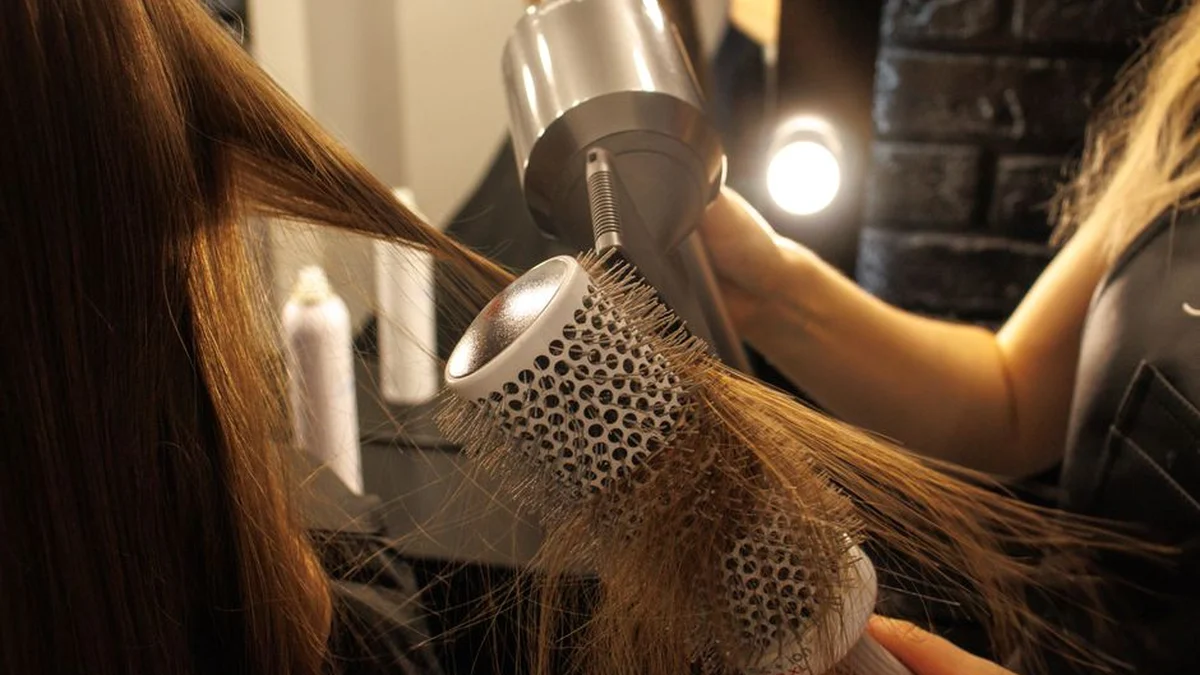
The concentrator nozzle. That flat plastic piece most people lose in a drawer. It focuses the airflow into a single direction, which is the entire reason a salon blow-dry looks smooth and yours does not. Without it, air hits the hair from all angles, lifts the cuticle and creates the frizz you are trying to dry out.
Point it down the hair shaft, root towards tip, so the cuticle is pushed flat rather than ruffled. Using a dryer bare, with air going everywhere, is the single most common technique mistake there is.
The diffuser. Spreads the airflow so it does not blow curl clumps apart. Low speed, medium heat, hovering rather than waving about. Anyone with curls or waves needs this more than they need a better dryer, and the curly hair products guide covers where it fits in the routine.
A cheap dryer with the right attachment beats an expensive one used bare. Every time.
The routine
Blot. Microfibre towel or an old cotton T-shirt, pressing rather than rubbing. Terry towelling catches the cuticle and lifts it.
Let it air dry to about seventy or eighty per cent if you have the time. This is the compromise the research supports: you skip the long soaking-wet phase and you skip most of the heat.
Heat protectant on damp hair, then let it dry in before the heat goes on. What to use and how much is in the heat protectant spray guide.
Nozzle on, pointing down the shaft.
15 to 20 centimetres, always moving.
Work in sections, from underneath upwards. The layer nearest your neck takes longest and gets forgotten.
Cool shot at the end. The shape sets as the hair cools, so a burst of cold air locks in what you just did. Skipping it is why a blow-dry drops within the hour. Same principle as the setting phase in heatless curls.
For volume
Dry the roots first, with your head flipped forward or the section lifted away from the scalp with a brush. Volume comes from hair drying in a lifted position, not from the dryer, which is also the whole principle behind hot rollers. A light curl enhancing mousse at the roots before you start holds it there once it sets.
Two British details
Voltage. UK dryers run at 230V. A dryer bought from a US site runs at 110V and will either underperform badly here or be destroyed, because a plug adaptor changes the shape of the pins and not the voltage. Going the other way, take a dual-voltage travel dryer rather than your good one.
Hard water lengthens the job. Across London, the South East and East Anglia, mineral deposits on the hair change how it holds water, and coated hair takes longer to dry. Longer drying means more heat exposure for the same result. If your hair suddenly seems to take forever, it may be limescale rather than the dryer, and the clarifying shampoo guide covers the chelating wash that shifts it.
Worth adding that a blow-dry does not survive a damp British afternoon on its own. What makes it hold is in the anti frizz hair products guide.
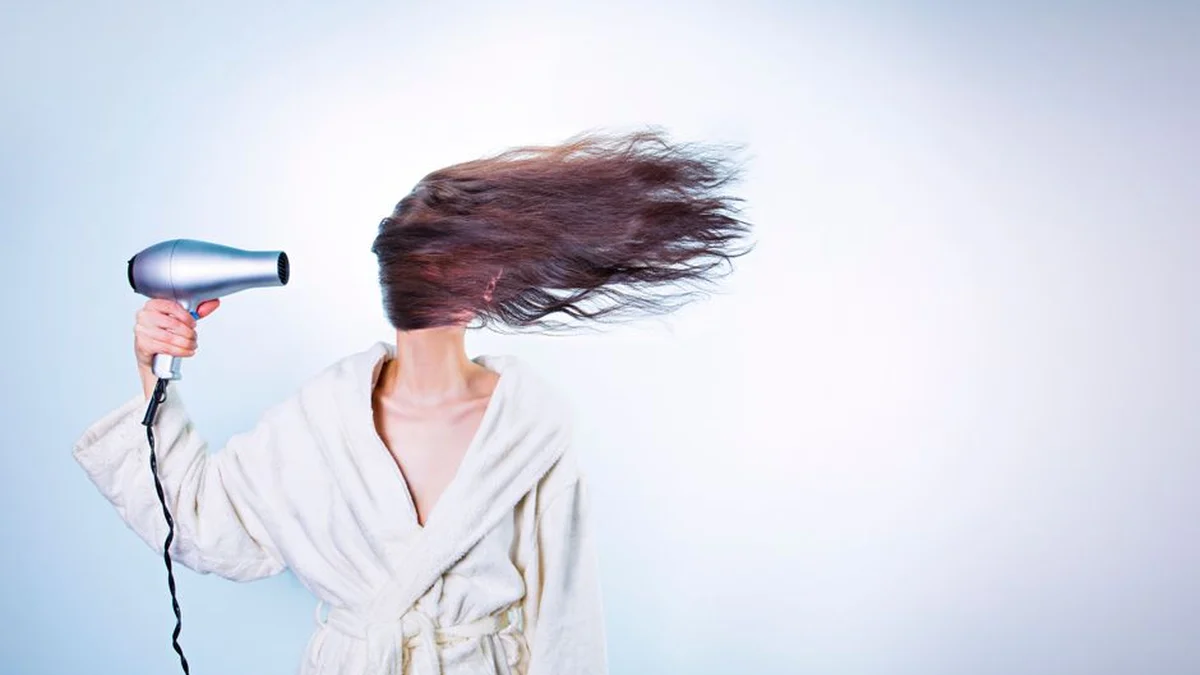
If your hair is coloured
Treated hair takes thermal damage faster at the same temperature, so drop a heat setting rather than a distance. Coloured hair is also more porous, which means it soaks up more water and takes longer to dry, so the temptation is to turn the heat up and you should do the opposite.
The hair colour care guide covers what else to change.
The short version
Air drying is not automatically the virtuous choice. Leaving hair soaking wet for hours does its own kind of damage, and a dryer held 15 centimetres away and kept moving does less harm than either extreme.
Blot, air dry most of the way, then finish with the nozzle on, pointing down the shaft, at arm’s length, moving constantly, and end on cool.
Buy for the motor and the airflow. Ignore tourmaline. Turn the ionic setting off if your hair is fine and keeps going flat.





Comments are closed