Band D Council Tax by English Region: Highest and Lowest Charging Councils
The average Band D council tax in England is £2,392 for 2026-27. See average bills for every English region, every band, and the highest and lowest councils.

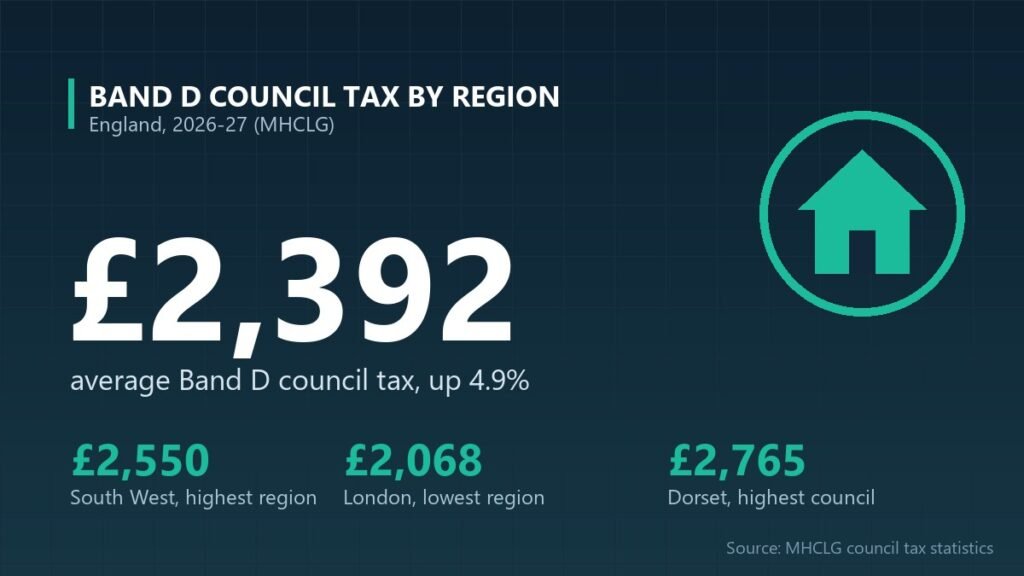
How much is Band D council tax? In England, the average Band D bill is £2,392 for 2026-27, an increase of £111, or 4.9 per cent, on last year, according to the Ministry of Housing, Communities and Local Government. That figure includes adult social care and parish precepts. Where you live makes a big difference: the average Band D bill ranges from £1,028 in Wandsworth to £2,765 in Dorset, and London is by far the cheapest region on average. Here is how every English region compares, part of our UK money and household bills coverage.
Key takeaways
- England average Band D: £2,392 in 2026-27, up £111 (4.9%).
- Highest region: the South West, averaging £2,550 for Band D.
- Lowest region: London, averaging £2,068.
- Highest and lowest councils: Dorset (£2,765) and Wandsworth (£1,028).
How much is Band D council tax in each region?
The South West and North East have the highest average Band D council tax in England, while London has the lowest. The table shows the average Band D bill for 2026-27 in each English region, including all council, police, fire, mayoral and parish charges.
| English region | Average Band D council tax 2026-27 | Difference from England average |
|---|---|---|
| South West | £2,550 | +£158 |
| North East | £2,535 | +£143 |
| North West | £2,479 | +£87 |
| South East | £2,472 | +£80 |
| East Midlands | £2,460 | +£68 |
| East of England | £2,394 | +£2 |
| West Midlands | £2,393 | +£1 |
| Yorkshire and The Humber | £2,390 | −£2 |
| London | £2,068 | −£324 |
| England | £2,392 | – |
Regional averages are Briton News calculations from MHCLG’s local authority data, weighting each council’s average Band D bill by its tax base. Our England figure matches the official £2,392 and our London figure matches the official £2,068. Regional year-on-year changes are not published. Scotland and Wales set their own council tax, and Northern Ireland uses a separate rates system.
Why does council tax vary so much between councils?
Council tax pays for the gap between what a council spends and what it receives from government grants, business rates and fees. Areas with a larger tax base, more grant funding or lower spending needs can charge less.
Why London is cheapest. Several central London boroughs, notably Wandsworth (£1,028) and Westminster (£1,050), have long set some of the lowest council tax charges in the country. Across inner London the average borough charge is just £1,240 before the Greater London Authority precept is added.
Why rural and county areas pay more. The highest bills are mostly in large rural or two-tier areas, such as Dorset (£2,765), Lewes (£2,756), Rutland (£2,738) and Wealden (£2,728), as well as the city of Nottingham (£2,755). Services such as adult social care, school transport and rural roads can be more costly to deliver over wide areas, and bills include separate charges from county councils, police, fire authorities and parish councils.
Budget pressures. Most councils raised bills as far as allowed this year: 274 of the 384 authorities subject to referendum limits used the maximum increase, and none exceeded its limit. Most councils with social care duties could raise bills by up to 5 per cent without a referendum, and a handful were given permission to go higher, including North Somerset, Shropshire and Worcestershire (up to 9 per cent).
How much is council tax for each band?
Every band is set as a fixed fraction of Band D, so a Band A home pays two-thirds of the Band D charge and a Band H home pays double. Based on the England average of £2,392, typical bills in 2026-27 are:
| Band | Property value (1 April 1991) | Share of Band D | England average 2026-27 |
|---|---|---|---|
| A | Up to £40,000 | 6/9 | £1,595 |
| B | £40,001 to £52,000 | 7/9 | £1,860 |
| C | £52,001 to £68,000 | 8/9 | £2,126 |
| D | £68,001 to £88,000 | 9/9 | £2,392 |
| E | £88,001 to £120,000 | 11/9 | £2,924 |
| F | £120,001 to £160,000 | 13/9 | £3,455 |
| G | £160,001 to £320,000 | 15/9 | £3,987 |
| H | Over £320,000 | 18/9 | £4,784 |
Bands in England are still based on what a home would have been worth on 1 April 1991. Bands A to C account for nearly two-thirds of all homes, which is why the average bill actually paid per home (£1,868 in 2026-27) is well below the Band D figure.
Can I pay less council tax?
Yes, in several situations. If you live alone, you can claim a 25 per cent single person discount. Students, some carers and people with a severe mental impairment can be disregarded, and households on low incomes may qualify for council tax reduction from their council. If you think your home is in the wrong band, you can ask the Valuation Office Agency to review it, but be aware that a review can move your band up as well as down.
Frequently asked questions
What is the average Band D council tax in England?
The average Band D council tax in England is £2,392 for 2026-27, including adult social care and parish precepts. That is £111, or 4.9 per cent, more than in 2025-26. Excluding parish precepts, the average is £2,343. The average bill actually paid per home is lower, at £1,868.
Which council has the highest council tax?
Dorset has the highest average Band D council tax in England for 2026-27, at £2,765 including all precepts. Lewes (£2,756), Nottingham (£2,755) and Rutland (£2,738) are close behind. Wandsworth in London has the lowest at £1,028, followed by Westminster at £1,050.
How much did council tax go up in 2026?
The average Band D council tax in England rose by 4.9 per cent, or £111, for 2026-27. The average bill per home rose by 5.5 per cent. Most councils responsible for social care could increase bills by up to 5 per cent without holding a local referendum, and none exceeded their limit.
Methodology and official sources
- Source: Ministry of Housing, Communities and Local Government, Council Tax levels set by local authorities in England 2026 to 2027, accredited official statistics published 25 March 2026.
- Data: Tables 1 to 9 and Table 10 (local authority level data). Council-level figures are the average Band D council tax for the area of each billing authority, including major and parish precepts.
- Regional averages: Briton News calculation weighting each billing authority’s area Band D figure by its council tax base for tax-setting purposes (2026-27). Results reproduce the published England (£2,392) and London (£2,068) averages.
- Bands: statutory band ratios and 1991 valuation bands for England.
- Link: GOV.UK: Council Tax levels set by local authorities in England 2026 to 2027.