Gender Pay Gap in the UK by Region: Latest ONS Data for Every Area
The UK gender pay gap for full-time workers fell to 6.8% in 2026, from 13.7% in London to minus 1.6% in Northern Ireland. See every region and age group.

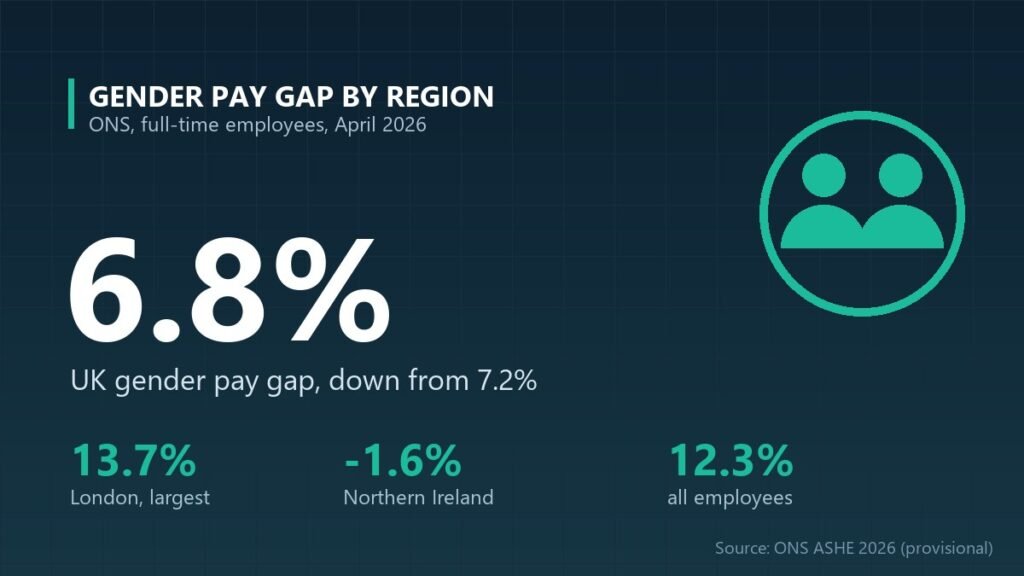
The gender pay gap in the UK by region ranges from minus 1.6 per cent in Northern Ireland, where women working full-time earn slightly more than men, to 13.7 per cent in London. Across the UK, the gap among full-time employees narrowed to 6.8 per cent in April 2026, down from 7.2 per cent a year earlier, according to the Office for National Statistics. Among all employees, including part-time workers, the gap was 12.3 per cent. Here is how every region and nation compares, and why the gap persists, part of our UK money and jobs data coverage.
Key takeaways
- UK full-time gap: 6.8% in April 2026, down from 7.2%.
- All employees: 12.3%, down from 13.0%.
- Largest regional gap: London, at 13.7% for full-time employees.
- Smallest: Northern Ireland (−1.6%), Scotland (0.9%) and Wales (3.2%).
What is the gender pay gap in each UK region?
London has the largest gender pay gap in the UK, followed by the South West and the South East, while all three devolved nations have smaller gaps than any English region. The table shows median hourly pay for full-time men and women, and the resulting gap, in April 2026.
| Region / nation | Men (full-time, hourly) | Women (full-time, hourly) | Full-time gap | All-employee gap |
|---|---|---|---|---|
| London | £29.66 | £25.60 | 13.7% | 15.4% |
| South West | £20.52 | £18.49 | 9.9% | 13.3% |
| South East | £22.05 | £19.88 | 9.8% | 15.5% |
| East Midlands | £19.15 | £17.46 | 8.8% | 12.1% |
| North West | £20.40 | £18.67 | 8.5% | 13.2% |
| East of England | £21.02 | £19.29 | 8.2% | 13.9% |
| West Midlands | £20.00 | £18.40 | 8.0% | 14.1% |
| Yorkshire and The Humber | £19.41 | £18.01 | 7.2% | 11.6% |
| North East | £18.87 | £17.93 | 5.0% | 10.2% |
| Wales | £19.45 | £18.84 | 3.2% | 8.2% |
| Scotland | £21.57 | £21.38 | 0.9% | 6.7% |
| Northern Ireland | £19.02 | £19.32 | −1.6% | 7.1% |
| United Kingdom | £21.51 | £20.05 | 6.8% | 12.3% |
The gap is the difference between men’s and women’s median hourly pay excluding overtime, as a percentage of men’s pay. A negative figure means women earn more. Figures are by place of work; English regional gaps are Briton News calculations from ONS medians and match the ONS ranking. Year-on-year regional changes are not published.
Why is the gender pay gap biggest in London?
London has the highest concentration of very well-paid jobs in finance, law and senior management, and men hold a larger share of the top-paying roles. That widens the gap at the median and especially at the top: across the UK, the full-time gap is 17.3 per cent at the 90th percentile of earnings, compared with 1.5 per cent at the 10th percentile.
The South East and South West also have gaps of almost 10 per cent. By contrast, in Scotland, Wales and Northern Ireland men’s and women’s full-time hourly pay is close to equal; in Scotland the difference is just 19p an hour, and in Northern Ireland women earn 30p more.
How does the gender pay gap change with age?
The gap is small for younger workers and grows from the late thirties onwards. Among full-time employees, it was just 0.3 per cent for 18 to 21 year olds and 4.1 per cent for 30 to 39 year olds, but rose to 8.2 per cent for 40 to 49 year olds and 11.0 and 11.2 per cent for those aged 50 to 59 and 60 and over.
The ONS links the larger gap among older employees to differences in the occupations men and women do. The timing also coincides with the years when many people have children, and women are more likely to move into part-time work: around 83 per cent of employee jobs done by men are full-time, compared with about 60 per cent of those done by women. For actual pay levels at each age, see our guide to the average salary in the UK by age.
Why is the gap bigger for all employees than full-time workers?
Because part-time jobs pay less per hour on average and women do far more of them. When part-time workers are included, the UK gap almost doubles, from 6.8 to 12.3 per cent. Among part-time workers alone, the gap is negative (minus 2.1 per cent), meaning part-time women earn slightly more per hour than part-time men.
The gap also varies by occupation. It is positive in all nine major occupation groups, and largest in skilled trades (12.7 per cent), process, plant and machine operatives (11.8 per cent) and among managers, directors and senior officials (11.4 per cent). Our breakdown of the average salary by UK region shows how overall pay levels compare.
Frequently asked questions
What is the gender pay gap in the UK in 2026?
The gender pay gap among full-time employees in the UK was 6.8 per cent in April 2026, down from 7.2 per cent in April 2025, according to the ONS. Among all employees, including part-time workers, it was 12.3 per cent, down from 13.0 per cent. These 2026 estimates are provisional.
Which region has the biggest gender pay gap?
London has the largest gender pay gap in the UK, at 13.7 per cent for full-time employees in April 2026, with men earning a median £29.66 an hour against £25.60 for women. The South West (9.9 per cent) and South East (9.8 per cent) follow.
Is the gender pay gap the same as unequal pay?
No. The gender pay gap compares average hourly pay for all men and women, regardless of their jobs. Unequal pay, paying men and women differently for the same or equivalent work, has been illegal in the UK since the Equal Pay Act 1970 and is now covered by the Equality Act 2010.
Methodology and official sources
- Source: Office for National Statistics, Gender pay gap in the UK: 2026, released 22 October 2026, based on the Annual Survey of Hours and Earnings (ASHE) 2026 provisional results.
- Dataset: ASHE Table 3.6a (hourly pay excluding overtime, by region and sex). English regional gaps are Briton News calculations from published medians; UK, Scotland, Wales and Northern Ireland full-time figures match those published by the ONS.
- Measure: median hourly earnings excluding overtime. The ONS figure is not comparable with employers’ own gender pay gap reports.
- Caveats: 2026 figures are provisional; final data are due in October 2027.
- Link: ONS: Gender pay gap in the UK: 2026.