Most Delayed Train Lines in the UK: Rail Punctuality Ranked by Operator
Avanti West Coast was Britain's least punctual train operator in April to June 2026, with 57.4% of stops on time. See every operator ranked for delays and cancellations.

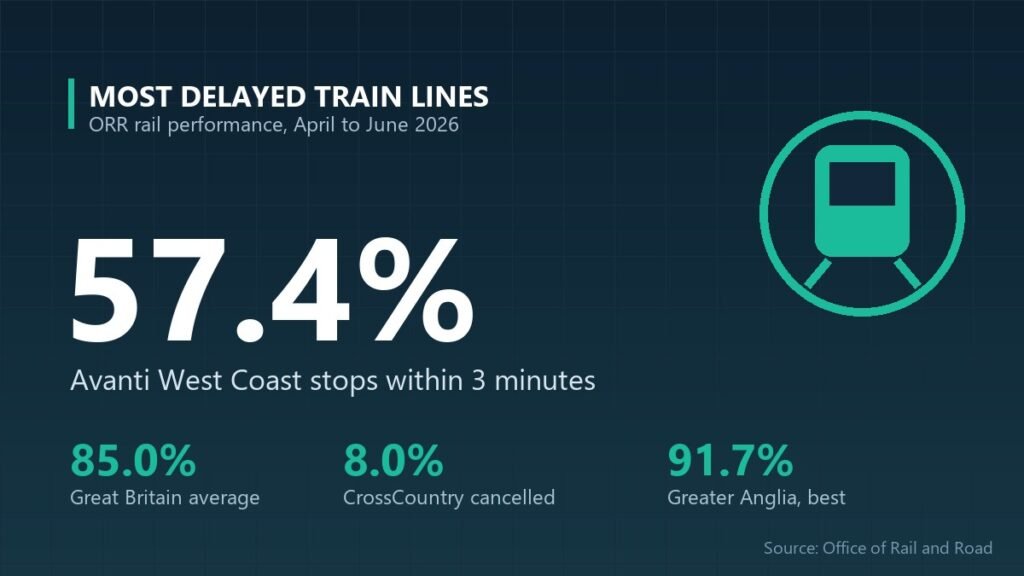
The most delayed train lines in the UK are long-distance intercity routes, led by Avanti West Coast, which ran just 57.4 per cent of its station stops within three minutes of schedule in April to June 2026, according to the Office of Rail and Road. Grand Central, CrossCountry and LNER were close behind. Across Great Britain, 85.0 per cent of stops were on time by that measure, down 1.3 percentage points on a year earlier, while cancellations rose to 4.1 per cent. Here is how every train operator compares, part of our coverage of how UK public services and transport perform.
Key takeaways
- Least punctual: Avanti West Coast, with 57.4% of stops within three minutes.
- Most punctual: Greater Anglia and Merseyrail, both at 91.7%.
- Most cancellations: CrossCountry, 8.0% of trains cancelled.
- Great Britain: 85.0% on time (within three minutes) and 4.1% cancelled, both worse than a year earlier.
What are the most delayed train lines in the UK?
Avanti West Coast, Grand Central and CrossCountry had the worst punctuality of any operator in April to June 2026. The table ranks every train operator by the share of station stops reached within three minutes of the timetable, with cancellations and the change on a year earlier.
| Train operator | Within 3 minutes | Change on year (pp) | On time (within 1 minute) | Cancelled | Change on year (pp) |
|---|---|---|---|---|---|
| Avanti West Coast | 57.4% | −1.1 | 38.0% | 7.1% | +3.3 |
| Grand Central | 60.0% | −7.3 | 40.6% | 3.6% | +0.8 |
| CrossCountry | 64.4% | −6.3 | 44.1% | 8.0% | +0.3 |
| London North Eastern Railway | 65.9% | −9.3 | 49.2% | 4.4% | +2.2 |
| Lumo (East Coast) | 66.2% | – | 52.2% | – | – |
| Hull Trains | 69.8% | −2.8 | 45.9% | 1.2% | −1.0 |
| Caledonian Sleeper | 71.6% | −1.7 | 61.0% | 3.3% | −0.6 |
| TransPennine Express | 71.7% | +1.6 | 51.7% | 4.1% | +0.1 |
| East Midlands Railway | 75.1% | −2.5 | 56.6% | 5.6% | +2.8 |
| Great Western Railway | 77.3% | −4.2 | 60.5% | 4.7% | +0.7 |
| Northern Trains | 80.0% | −0.8 | 61.0% | 3.3% | 0.0 |
| West Midlands Trains | 82.3% | −2.7 | 65.6% | 4.7% | +1.5 |
| South Western Railway | 83.8% | −1.9 | 67.9% | 5.2% | +1.8 |
| Greater Thameslink Railway | 85.5% | – | 69.7% | 5.3% | – |
| Southeastern | 85.5% | −1.8 | 68.5% | 2.7% | +0.6 |
| TfW Rail | 86.2% | +2.5 | 72.2% | 5.0% | +0.8 |
| Chiltern Railways | 88.3% | −1.4 | 77.4% | 1.6% | +0.1 |
| ScotRail | 89.4% | −1.5 | 70.2% | 1.8% | +0.2 |
| Elizabeth line | 89.9% | −2.1 | 78.4% | 4.1% | +1.5 |
| London Overground | 90.0% | −0.7 | 69.9% | 5.4% | +1.6 |
| Heathrow Express | 90.4% | −0.4 | 76.8% | 5.4% | +2.7 |
| c2c | 91.6% | −2.1 | 77.4% | 2.9% | +1.1 |
| Merseyrail | 91.7% | +1.6 | 70.7% | 3.0% | +0.3 |
| Greater Anglia | 91.7% | −1.7 | 81.9% | 2.3% | +0.7 |
| Great Britain | 85.0% | −1.3 | 68.1% | 4.1% | +0.9 |
“Within 3 minutes” (Time to 3) is the share of recorded station stops reached early or less than three minutes late. Cancellations count full cancellations as one and part cancellations as half. Greater Thameslink Railway (formerly Govia Thameslink Railway) and Lumo have no comparable year-earlier figures in this table. Lumo’s West Coast service, launched in May 2026, is not shown. Data for April to June 2026 is provisional.
Why are long-distance trains the most delayed?
Intercity operators run long routes that cross many busy junctions and share tracks with commuter and freight services, so a problem anywhere on a route of several hundred miles can make a train late. A train from London to Glasgow or Edinburgh has far more chances to be delayed than a short suburban hop, which is why the bottom of the table is dominated by Avanti West Coast, CrossCountry, LNER, Grand Central and Lumo.
LNER had the biggest deterioration of any operator, with punctuality down 9.3 percentage points on a year earlier, while Avanti West Coast saw the largest rise in cancellations, up 3.3 points. Only three of 25 operators improved their punctuality: TfW Rail (up 2.5 points), and TransPennine Express and Merseyrail (each up 1.6 points).
Shorter, self-contained networks perform best. Merseyrail, c2c, Greater Anglia and Heathrow Express all reached at least 90 per cent of stops within three minutes.
Which train operators cancel the most trains?
CrossCountry cancelled the highest share of its trains, 8.0 per cent, followed by Avanti West Coast (7.1 per cent) and East Midlands Railway (5.6 per cent). Hull Trains had the fewest cancellations at 1.2 per cent, followed by Chiltern Railways (1.6 per cent) and ScotRail (1.8 per cent). Across Great Britain, 54,700 trains were fully cancelled and 48,000 part cancelled in the quarter, and there were 17 severely disrupted days when more than 5 per cent of trains were cancelled, 11 more than a year earlier.
Can I get compensation for a delayed train?
Yes. Most operators run Delay Repay, which pays compensation if your train arrives at least 15 minutes late, with higher amounts for longer delays, and some pay from 30 minutes. You claim through the operator whose train you were delayed on, usually online within 28 days, with your ticket details. Check your operator’s website for its exact scheme.
Frequently asked questions
Which is the worst train company in the UK for delays?
Avanti West Coast had the worst punctuality in Great Britain in April to June 2026, with only 57.4 per cent of station stops reached within three minutes of schedule, according to the Office of Rail and Road. Grand Central (60.0 per cent) and CrossCountry (64.4 per cent) were next.
Which train company is the most punctual?
Greater Anglia and Merseyrail were the most punctual operators in April to June 2026, each reaching 91.7 per cent of stops within three minutes. Greater Anglia also had the highest share arriving within one minute, at 81.9 per cent. c2c (91.6 per cent) was close behind.
Are UK trains getting worse?
In the latest quarter, yes. Punctuality in Great Britain fell to 85.0 per cent of stops within three minutes in April to June 2026, down 1.3 percentage points on a year earlier, and cancellations rose 0.9 points to 4.1 per cent. Punctuality worsened for 22 of 25 operators.
Methodology and official sources
- Source: Office of Rail and Road, Passenger rail performance: April to June 2026, published 17 September 2026, with Table 3133 (train punctuality by operator) and Table 3123 (trains planned and cancellations by operator). Data from Network Rail.
- Coverage: Great Britain only; Northern Ireland’s rail network is run separately and not included.
- Next update: figures for July to September 2026 are due on 10 December 2026.
- Link: ORR data portal: passenger rail performance.