Average Broadband Speed in the UK: Full Fibre Coverage by Region Ranked
The UK average maximum broadband speed is 285 Mbit/s, and full fibre reaches 82% of homes. See speeds by nation and full fibre coverage in every region.

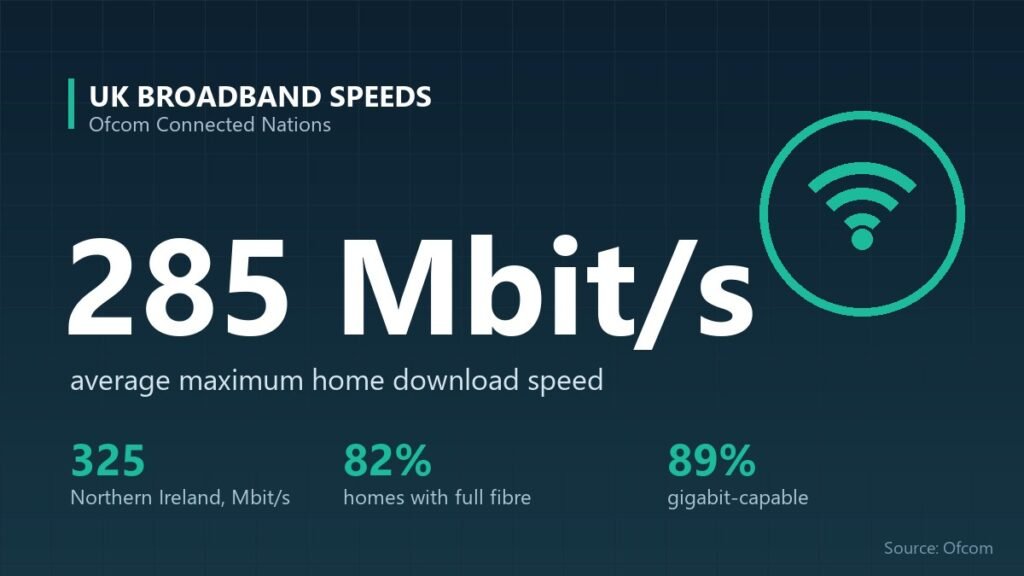
What is the average broadband speed in the UK? According to Ofcom, the average maximum download speed delivered to UK homes reached 285 Mbit/s in 2025, up almost 30 per cent in a year, as more households switch to full fibre. Northern Ireland has the fastest average at 325 Mbit/s and Wales the slowest at 243 Mbit/s. Full fibre is now available to 82 per cent of UK homes and gigabit-capable broadband to 89 per cent, although coverage ranges from over 99 per cent in Hull to 11 per cent in the Western Isles. Here is how every nation and English region compares, part of our coverage of how UK public services and infrastructure compare.
Key takeaways
- Average speed: 285 Mbit/s average maximum download speed in the UK (July 2025), up from 223 Mbit/s.
- Fastest nation: Northern Ireland, 325 Mbit/s; slowest: Wales, 243 Mbit/s.
- Full fibre: available to 82% of UK homes (January 2026); gigabit-capable: 89%.
- No decent broadband: about 39,000 premises still cannot get 10 Mbit/s from a fixed line or fixed wireless.
What is the average broadband speed in each UK nation?
Northern Ireland has the fastest broadband in the UK, with an average maximum download speed of 325 Mbit/s, while Wales is slowest at 243 Mbit/s. The table shows Ofcom’s average maximum speeds for each nation over three years, plus average monthly data use.
| Nation | Average max speed 2023 | 2024 | 2025 | Annual change | Average data use per month (2025) |
|---|---|---|---|---|---|
| Northern Ireland | 191 Mbit/s | 259 Mbit/s | 325 Mbit/s | +25% | 551 GB |
| England | 173 Mbit/s | 225 Mbit/s | 288 Mbit/s | +28% | 591 GB |
| Scotland | 155 Mbit/s | 215 Mbit/s | 273 Mbit/s | +27% | 530 GB |
| Wales | 136 Mbit/s | 181 Mbit/s | 243 Mbit/s | +34% | 560 GB |
| UK | 170 Mbit/s | 223 Mbit/s | 285 Mbit/s | +28% | 583 GB |
The “average maximum” speed is the mean of the maximum download speeds that providers’ systems report delivering to customers’ routers, so it reflects the packages and technologies people actually use. Ofcom’s last measured median home speed, from tests in March 2023, was 69.4 Mbit/s; it has since stopped that research because speed is no longer a limiting factor for most users.
Which regions have the best full fibre coverage?
Northern Ireland, Yorkshire and The Humber and the North West have the widest full fibre coverage, while Scotland and the South West have the least. The table shows the share of homes able to get full fibre, gigabit-capable and superfast broadband in January 2026.
| Region / nation | Full fibre | Gigabit-capable | Superfast (30 Mbit/s+) | Homes unable to get decent broadband |
|---|---|---|---|---|
| Northern Ireland | 95.5% | 96.3% | 98.9% | 1,238 |
| Yorkshire and The Humber | 91.9% | 94.2% | 98.6% | 1,297 |
| North West | 89.0% | 92.7% | 98.4% | 1,378 |
| East Midlands | 85.2% | 90.5% | 98.3% | 2,141 |
| West Midlands | 83.4% | 91.3% | 98.2% | 1,606 |
| Wales | 82.5% | 84.9% | 97.1% | 4,673 |
| North East | 80.3% | 92.1% | 98.6% | 965 |
| East of England | 78.4% | 87.0% | 98.5% | 2,972 |
| London | 78.1% | 91.2% | 98.7% | 66 |
| South East | 78.1% | 86.5% | 98.2% | 2,867 |
| South West | 76.0% | 82.0% | 96.6% | 4,434 |
| Scotland | 74.9% | 83.5% | 97.2% | 7,256 |
| UK | 82% | 89% | 98% | about 31,000 homes |
Regional figures are Briton News calculations from Ofcom’s January 2026 local authority data for residential premises, grouped by region (excluding the City of London and Isles of Scilly); they match Ofcom’s published UK totals. “Decent” broadband means at least 10 Mbit/s download and 1 Mbit/s upload from a fixed line or fixed wireless network. Across all premises, including businesses, Ofcom puts the total at about 39,000.
Why is broadband faster in some parts of the UK?
Speed depends on which network reaches your street. Full fibre runs fibre-optic cable all the way to the home and can deliver gigabit speeds, while older part-fibre (FTTC) connections rely on copper for the final stretch and slow down the further a home is from the street cabinet.
Northern Ireland’s lead comes from early, large-scale full fibre roll-out: 95.5 per cent of homes can get it. Hull is an outlier too: the city’s long-standing local network gives it the highest full fibre coverage of any council area, at 99.8 per cent.
Rural and island areas lag behind because laying fibre to scattered homes costs more per property. Ofcom’s 2025 data shows 61 per cent of rural UK homes could get full fibre, against 81 per cent in towns and cities. The lowest coverage is in the Scottish islands: Na h-Eileanan Siar (11.3 per cent), Shetland (20.6 per cent) and Orkney (30.7 per cent), along with Argyll and Bute (24.5 per cent).
London is a different case. Almost every home can get superfast broadband and 91.2 per cent can get gigabit speeds, mostly over cable networks, but full fibre coverage (78.1 per cent) is below average, partly because fitting fibre into flats and older blocks is more complex.
What is a good broadband speed?
For most households, a connection of 30 Mbit/s or more, which Ofcom calls superfast, handles HD streaming, video calls and home working. Busy homes with several people streaming in 4K or gaming at once benefit from 100 Mbit/s or more. Ofcom’s figures show that 55 per cent of full fibre customers choose packages of 300 Mbit/s or less, and 21 per cent take gigabit (900 Mbit/s+) deals.
If you cannot get at least 10 Mbit/s download and 1 Mbit/s upload, you may be able to request a better connection under the broadband Universal Service Obligation.
Frequently asked questions
What is the average broadband speed in the UK in 2026?
Ofcom’s latest figures put the UK average maximum home broadband download speed at 285 Mbit/s, measured in July 2025 and published in its Connected Nations 2025 report. That is up from 223 Mbit/s a year earlier. England averaged 288 Mbit/s, Northern Ireland 325, Scotland 273 and Wales 243.
How many UK homes can get full fibre?
Full fibre broadband was available to 24.9 million UK homes, or 82 per cent, in January 2026, according to Ofcom, up 1.2 million in six months. Gigabit-capable broadband, including upgraded cable networks, reached 89 per cent of homes. Northern Ireland has the highest full fibre coverage at about 95 per cent.
Which part of the UK has the worst broadband?
The Scottish islands have the lowest full fibre coverage: just 11.3 per cent of homes in Na h-Eileanan Siar and 20.6 per cent in Shetland could get it in January 2026. Among nations, Wales has the slowest average maximum speed, at 243 Mbit/s, and Scotland the lowest full fibre coverage.
Methodology and official sources
- Speeds and data use: Ofcom, Connected Nations UK report 2025, published 19 November 2025, Tables 2.1, 2.7, 2.8, 2.9 and 2.10 (provider data, July 2025).
- Coverage: Ofcom, Connected Nations update: Spring 2026, published 13 May 2026, summary tables and local authority residential coverage data (January 2026).
- Regional figures: Briton News calculation, summing Ofcom’s local authority premises counts by region.
- Historic median speed: Ofcom’s UK Home Broadband Performance research (March 2023 measurements), since discontinued.
- Next update: Ofcom’s next annual Connected Nations report; this page will be refreshed when it is published.
- Links: Ofcom: Connected Nations update, Spring 2026.