Average Monthly Mortgage Payment in the UK by Region: Affordability Breakdown
Buying an average UK home with a 15% deposit costs about £1,307 a month at today's rates, from £798 in the North East to £2,612 in London. See every region.

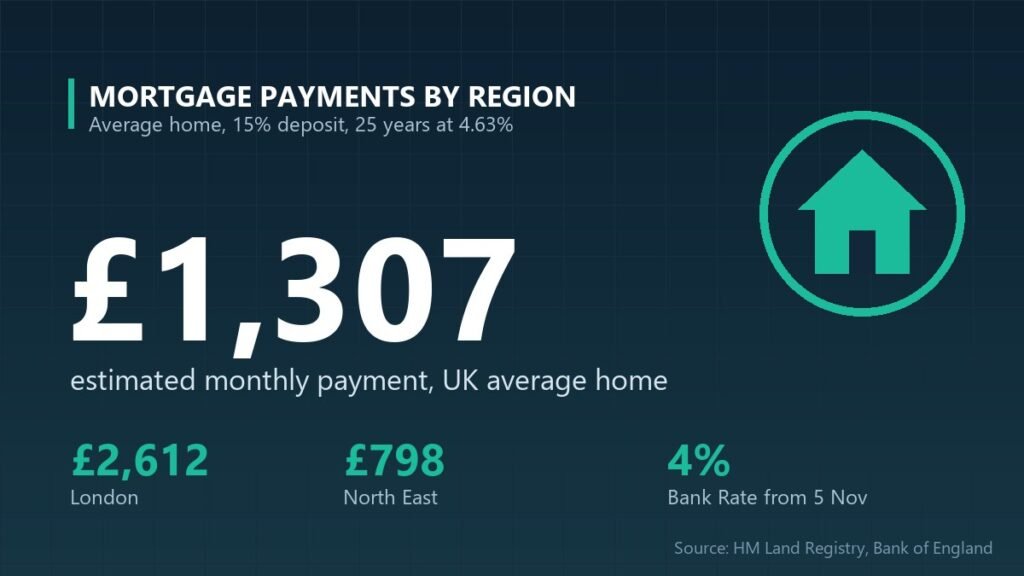
The average monthly mortgage payment in the UK by region ranges from about £800 in the North East to over £2,600 in London for a buyer purchasing an average-priced home today, on Briton News calculations using official house prices and interest rates. For a typical UK home costing £273,000, a buyer with a 15 per cent deposit would pay around £1,307 a month on a 25-year repayment mortgage at 4.63 per cent, the Bank of England’s latest average rate on new mortgages. With Bank Rate raised to 4 per cent in November 2026, here is what buyers can expect to pay in every region, part of our UK property market data.
Key takeaways
- UK average: about £1,307 a month on a £232,050 mortgage (average home, 15% deposit, 25 years, 4.63%).
- Highest: London, about £2,612 a month, or 76% of typical full-time take-home pay.
- Lowest: the North East, about £798 a month, or 32% of take-home pay.
- Interest rates: new mortgages averaged 4.63% in September 2026; Bank Rate rose to 4% on 5 November.
What is the average monthly mortgage payment in each UK region?
A buyer of an average-priced home in London would pay more than three times as much each month as a buyer in the North East. The table shows the estimated monthly repayment for each region, based on the average house price, a 15 per cent deposit and a 25-year repayment mortgage at 4.63 per cent.
| Region / nation | Average house price | 15% deposit | Monthly payment (25 years) | Monthly payment (30 years) | Share of median take-home pay |
|---|---|---|---|---|---|
| London | £545,579 | £81,836 | £2,612 | £2,386 | 75.8% |
| South East | £378,915 | £56,837 | £1,814 | £1,657 | 65.0% |
| East of England | £338,357 | £50,753 | £1,620 | £1,480 | 59.4% |
| South West | £301,616 | £45,242 | £1,444 | £1,319 | 54.7% |
| East Midlands | £242,863 | £36,429 | £1,163 | £1,062 | 46.3% |
| West Midlands | £250,355 | £37,553 | £1,199 | £1,095 | 45.9% |
| Wales | £214,548 | £32,182 | £1,027 | £938 | 40.6% |
| North West | £220,477 | £33,071 | £1,056 | £964 | 40.5% |
| Yorkshire and The Humber | £210,799 | £31,619 | £1,009 | £922 | 39.7% |
| Northern Ireland | £207,272 | £31,090 | £992 | £906 | 38.4% |
| Scotland | £197,975 | £29,696 | £948 | £866 | 34.2% |
| North East | £166,649 | £24,997 | £798 | £729 | 32.2% |
| United Kingdom | £273,000 | £40,950 | £1,307 | £1,194 | 47.6% |
These are illustrative Briton News calculations, not actual average payments. House prices are September 2026 averages from the UK House Price Index (Northern Ireland: July to September 2026). Take-home pay is for one full-time worker on the regional median salary. Actual payments depend on your deposit, term, mortgage rate and the home you buy.
Is it cheaper to rent or buy in each region?
In most regions, the monthly cost of a mortgage on an average home is now close to the average rent, but buying also requires a deposit. In the North East, the estimated mortgage payment of £798 is almost identical to the average rent of £793. In London, the £2,612 mortgage payment is about £260 a month more than the average rent of £2,350, on top of an £81,836 deposit. Our guide to the average monthly rent in every UK region has the full rent figures.
Bear in mind that a mortgage payment pays off part of the loan each month, while rent does not, but homeowners also pay for repairs, maintenance and insurance that landlords usually cover.
How do interest rates affect mortgage payments?
Small changes in rates make a noticeable difference. On the UK average mortgage of £232,050 over 25 years:
- at 4.63 per cent, the monthly payment is about £1,307;
- a rate 0.25 points higher (4.88 per cent) adds about £33 a month;
- a rate 0.5 points lower (4.13 per cent) saves about £65 a month;
- a rate one point higher (5.63 per cent) adds about £136 a month.
Over the full 25 years at 4.63 per cent, the borrower would pay around £160,000 in interest on top of the amount borrowed. The Bank of England raised Bank Rate from 3.75 to 4 per cent on 5 November 2026, which affects tracker and variable-rate mortgages straight away and tends to feed into new fixed-rate deals over time. Its next decision is due on 17 December 2026.
Why are mortgage costs so different across the UK?
The cost of a mortgage depends mostly on how much you borrow, and that is driven by house prices, which vary far more than wages. London’s average house price is more than three times the North East’s, while its median full-time salary is only about 46 per cent higher. That is why a London mortgage takes three-quarters of typical take-home pay, against about a third in the North East and Scotland. Our list of the cheapest places to buy a house in the UK shows where homes are most affordable relative to local wages.
Frequently asked questions
What is the average mortgage payment in the UK?
For a buyer of an average-priced UK home (£273,000) with a 15 per cent deposit, a 25-year repayment mortgage at the Bank of England’s latest average new-mortgage rate of 4.63 per cent costs about £1,307 a month, on Briton News calculations. Over 30 years it would be about £1,194 a month.
What is the current mortgage interest rate in the UK?
The effective interest rate on new mortgages was 4.63 per cent in September 2026, up from 4.60 per cent in August, according to the Bank of England. The rate on all outstanding mortgages was 4.03 per cent. Bank Rate was raised to 4 per cent on 5 November 2026.
How much deposit do I need to buy a house?
Most lenders require at least 5 to 10 per cent, but a bigger deposit usually gets a lower rate. On an average UK home of £273,000, a 10 per cent deposit is £27,300 and 15 per cent is £40,950. In London the average home needs £54,558 for 10 per cent; in the North East, £16,665.
Methodology and official sources
- House prices: HM Land Registry, UK House Price Index: September 2026, published 18 November 2026.
- Mortgage rate: Bank of England, Effective interest rates: September 2026 (published 29 October 2026): effective rate on new secured lending to individuals, 4.63%.
- Bank Rate: Bank of England, Monetary Policy Committee decision of 5 November 2026 (Bank Rate 4%).
- Calculations: standard repayment mortgage formula, 15% deposit, monthly payments over 25 or 30 years. Take-home pay uses median full-time salaries from the ONS Annual Survey of Hours and Earnings 2026 (provisional) and 2026-27 tax and National Insurance rates (Scottish income tax in Scotland).
- Caveats: illustrative estimates for a new purchase at average prices; existing borrowers’ payments depend on when they borrowed and their rate.