Highest Paying Jobs in the UK: Top 25 Occupations Ranked by Median Pay
Hospital consultants and other specialist doctors earn a median £108,281, the most of any UK job. See the top 25 highest paying occupations from ONS data.

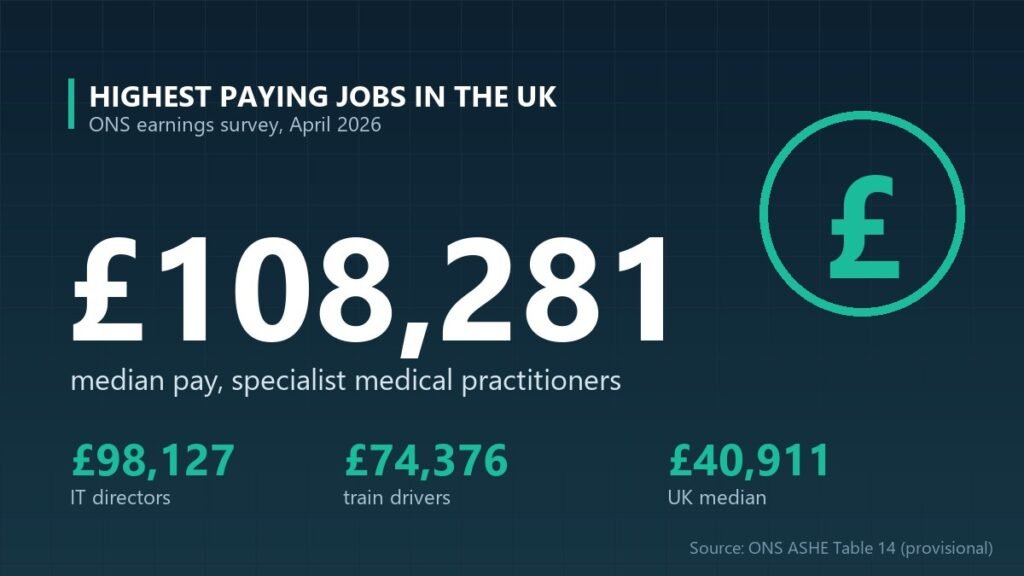
The highest paying jobs in the UK are led by specialist medical practitioners, such as hospital consultants, who earned a median of £108,281 a year working full-time in April 2026, according to the Office for National Statistics. IT directors (£98,127), marketing and sales directors (£96,393) and chief executives (£95,516) follow. Outside management, train drivers stand out at £74,376, more than many professional roles. Here are the top 25 occupations ranked by median full-time pay, part of our UK money and jobs data coverage.
Key takeaways
- Highest paid: specialist medical practitioners, median £108,281 a year (full-time, April 2026).
- Top non-management job: train and tram drivers, at £74,376.
- Tech pays well: IT directors earn £98,127; software developers £59,862.
- UK median for comparison: £40,911 for all full-time employees.
What are the highest paying jobs in the UK?
Senior doctors, company directors and chief executives top the list of the UK’s best-paid occupations. The table ranks the 25 highest-paying jobs by median gross annual pay for full-time employees in April 2026, including only occupations with reliable estimates.
| Rank | Occupation | Median full-time salary | Annual change |
|---|---|---|---|
| 1 | Specialist medical practitioners | £108,281 | +8.1% |
| 2 | Information technology directors | £98,127 | +3.3% |
| 3 | Marketing, sales and advertising directors | £96,393 | +2.9% |
| 4 | Chief executives and senior officials | £95,516 | −5.1% |
| 5 | Functional managers and directors (other) | £84,439 | +8.3% |
| 6 | Financial managers and directors | £80,000 | +4.5% |
| 7 | Public relations and communications directors | £79,560 | – |
| 8 | Train and tram drivers | £74,376 | −2.6% |
| 9 | Head teachers and principals | £73,110 | +1.2% |
| 10 | Senior police officers | £70,573 | +5.6% |
| 11 | IT business analysts, architects and systems designers | £64,326 | +6.5% |
| 12 | Health services and public health managers and directors | £63,574 | +2.1% |
| 13 | Electrical engineers | £63,136 | +3.5% |
| 14 | Business and financial project management professionals | £63,046 | +5.4% |
| 15 | Managers and directors in the creative industries | £61,634 | +11.8% |
| 16 | Human resource managers and directors | £61,445 | +6.4% |
| 17 | Actuaries, economists and statisticians | £60,263 | +13.3% |
| 18 | Production managers and directors in construction | £59,994 | +7.3% |
| 19 | Programmers and software development professionals | £59,862 | +5.4% |
| 20 | Production managers and directors in manufacturing | £59,695 | +2.0% |
| 21 | IT project managers | £59,647 | +0.4% |
| 22 | Generalist medical practitioners (GPs) | £59,325 | +5.6% |
| 23 | Purchasing managers and directors | £59,192 | +2.1% |
| 24 | IT professionals (other) | £59,048 | +8.3% |
| 25 | Business, research and administrative professionals (other) | £58,847 | +0.4% |
Figures are medians for full-time employees in the same job for at least a year. The list excludes occupations where the ONS estimate is unreliable or suppressed because of small samples, such as directors in logistics and aircraft pilots. Annual changes for small occupations can be volatile.
Why are doctors and directors paid the most?
The best-paid jobs combine long training, scarce skills and senior responsibility. Specialist medical practitioners, such as hospital consultants, typically train for well over a decade after starting medical school, and their median salary of £108,281 is more than two and a half times the UK full-time median of £40,911. Directors and chief executives are paid for running large organisations, and their pay often includes bonuses on top of salary.
Technology skills are also well rewarded. IT directors are the second best-paid occupation, and four IT roles appear in the top 25, from systems designers (£64,326) to software developers (£59,862).
Which well-paid jobs do not need a degree?
Train and tram drivers are the stand-out example. With a median full-time salary of £74,376, they earn more than most managers and professionals, and the role is usually learned through employer training schemes rather than a university degree. Police officers at sergeant level and below earn a median of £52,569, also well above the national median. For a comparison of how pay changes over a career, see our guide to the average salary in the UK by age.
What are the lowest paid jobs in the UK?
At the other end of the scale, hospitality, retail and education support roles pay the least. Coffee shop workers had the lowest median full-time pay at £21,376, followed by teaching assistants (£22,018), educational support assistants (£22,699), playworkers (£23,118) and bar staff (£23,676). Many of these jobs are paid at or near the National Living Wage, set out in our guide to the UK minimum wage and take-home pay.
How much do other popular professions earn?
Many well-known professional jobs pay between £45,000 and £60,000 for full-time employees. Solicitors and lawyers earn a median of £57,198, pharmacists £55,410, civil engineers £52,456, quantity surveyors £52,492, veterinarians £51,113, secondary school teachers £49,492, architects £47,665 and midwives £47,552.
Frequently asked questions
What is the highest paying job in the UK?
Specialist medical practitioners, a group that includes hospital consultants, had the highest median full-time salary of any occupation in the UK in April 2026, at £108,281 a year, according to the ONS. IT directors (£98,127) and marketing, sales and advertising directors (£96,393) were next.
How much do train drivers earn in the UK?
Train and tram drivers earned a median of £74,376 a year working full-time in April 2026, according to the ONS Annual Survey of Hours and Earnings. That puts them eighth among all occupations and well above the UK full-time median of £40,911.
Why are some well-paid jobs missing from the list?
The ONS only publishes reliable estimates, so some occupations with small survey samples, such as aircraft pilots, have no published median for 2026. The survey also covers employees only, so self-employed workers such as many barristers, GP partners and contractors are not included.
Methodology and official sources
- Source: Office for National Statistics, Employee earnings in the UK: 2026, ASHE Table 14 (occupation by four-digit SOC 2020), Table 14.7a (annual gross pay) and 14.7b (coefficients of variation), 2026 provisional, released 22 October 2026.
- Measure: median gross annual pay for full-time employees who have been in their job for more than a year.
- Quality: the top 25 includes only occupations with a median coefficient of variation of 10 per cent or less (estimates the ONS describes as precise or reasonably precise).
- Caveats: employees only; 2026 figures are provisional and will be revised in October 2027.
- Link: ONS: Occupation (4-digit SOC), ASHE Table 14.